Showing posts with label Sin. Show all posts

Saturday, March 14, 2015

BRATS AND CONVERSION


SCHOOL BRATS


A word that has come up a few times recently at our daily school assembly is “brat,” as in “You are acting like a bunch of brats.” It comes up when certain students refuse to stop talking when the signal for silence is given. These kids just unthinkingly keep on doing what they want to do, following their own agendas instead of the community's. To do that is, in the Headmaster’s opinion, to act like  brat. I’m afraid that we’re seeing more and more kids who apparently get away with that behavior at home and then bring it into school with them. No one has ever told them to subordinate their own wishes to the needs of others, so they just act like brats.


BIBLICAL BRATS


This Friday morning's first reading at mass ended with this strange phrase: 
"Straight are the paths of the Lord,
in them the just walk,
but sinners stumble in them." (Hosea 14:10)
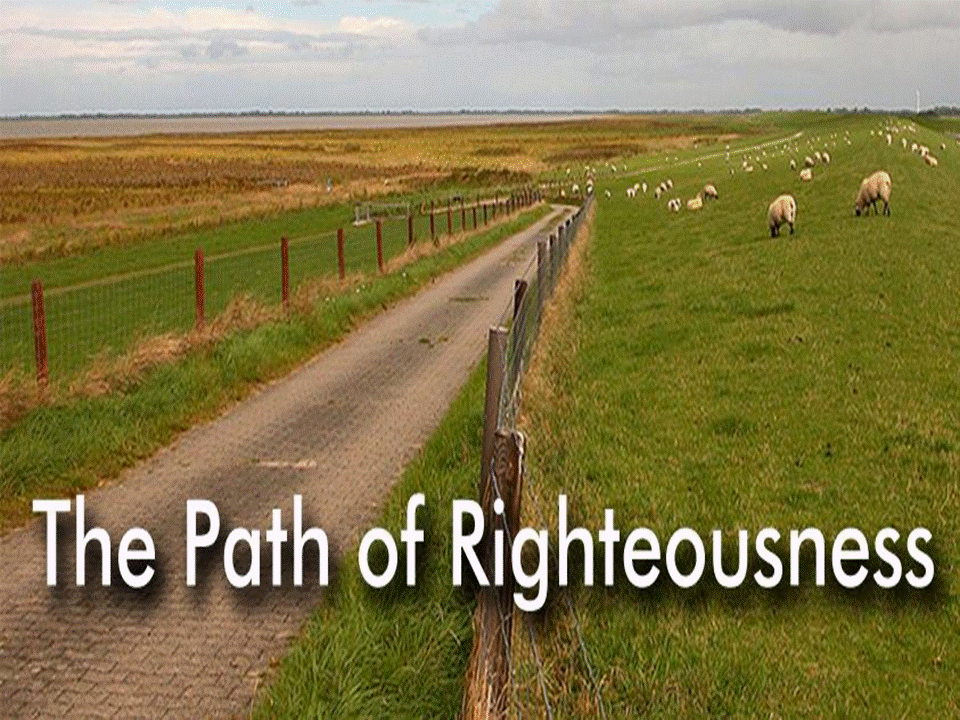

I pondered for a while why or how people could stumble if they were walking on the straight, correct path. 

There are plenty of places in the bible that speak of the "two paths," -- the wrong one being the way of evil which is trod by the wicked whose right hand is filled with bribes and who rob orphans and widows. I find it unrealistic to identify with those criminals, but that means that I have to identify myself as one of "the just ones," which smscks of complacency and presumption. Hold that thought.

Back to the image of people who stumble while following "the path of the Lord." I finally looked at the biblical references for Hosea 4:10 in my bible and was sent to this verse from the prophet Micah:

"You have been told, O mortal, what is good.
and what the Lord requires of you:
Only to do justice and to love goodness,
and to walk humbly with your God." 
(Micah 6:8)


There it was: at least one answer as to how some people get tripped up even while following God’s path. They’re not wicked people, they have no evil intentions or anything like that. They just forget to walk humbly with their God. "Walking humbly" means doing what God wants you to do, however unimportant it seems to you, and subjecting your will to what God asks of you, rather than putting your own agenda first. Hmm... That last phrase had a familiar ring to it… That's right! You got it: It’s the very description of a BRAT! Someone who won’t submit his or her agenda to someone else’s. Hah! So Hosea was talking about Biblical Brats!


THAT BRAT IS YOU!


I had discovered a new biblical category of people: spiritual brats; they're basically good well-intentioned folks whose lack of humility can sometimes cause them to stumble in the way of righteousness. I then moved on to the next step in my reflection, the question that should always be part of lectio: What does this say to ME? How does this apply to my life?


And then it hit me: My relationship with the Lord gets weak and troubled when I start acting like a brat -- Like the freshman who prefers doing his own thing to doing what is demanded by the greater good. I try various excuses and explanations for not doing what God asks of me but the fact remains that clearly I’m acting like a brat. Wow, does that shoe fit!


BRATS AND LENT

Lent seems to be the perfect time for dealing with one's inner brat. Walking the forty-day Pilgrim Road of self denial, extra prayer and other disciplines can really provoke the spoiled brat in each of us. This then gives us a clear choice not between being good or being wicked, but rather between following our own selfish agenda or doing what we know God wants of us. "Walking humbly with God" means doing things God's way, imitating the example of our Savior in Gethsemane who said "Not my will but yours be done."
.

Okay, so maybe it worked for Frank.


.

Saturday, January 31, 2015

WEEDS OR WHEAT?

X
ME AND MY WEEDS


The other morning I was reading the parable of the weeds planted among the weeds in Mt. 13. You may remember the story: an enemy had sown weeds in the master’s field, but the master advised the field hands to just let both grow together until harvest time rather than trying the risky procedure of pulling up the weeds while the wheat was still growing.


The parable offers lots of food for reflection. For instance, the weeds closely resemble the wheat itself in the early stages, so Jesus is cautioning his followers not to be too enthusiastic about rooting out the “sinners” in their community because in their enthusiasm they may be pulling up wheat that just happens at this stage to look like weeds. He advises us to leave God in charge of distinguishing the weeds from the wheat.

AN UNSETTLING THOUGHT


But what caught my eye that morning was a footnote in the New American Bible for Mt 13:27 saying that "weeds" refers to a troublesome plant that resembles wheat and (get this!) is poisonous.  I’d never heard this latter fact before, nor could I verify it in either of the two dictionaries of biblical Greek when I looked up zizania (Greek for "weeds") later. But nevertheless this little fact was the center of a powerful reflection that morning. It went like this:


There have always been weeds in my life and in my relationship with God, little things that shouldn’t be there, but that at their worst are, as the Greek dictionaries put it, “troublesome.” They’re like the weeds in a flower garden: they spoil the appearance of the place but don’t really do any real harm unless, of course, you let them get totally out of control. 

So I just don’t pay too much attention to my weeds - those harmless little habits and careless actions that aren’t really Christlike but that are just a normal part of being an imperfect human being. But what if those weeds are poisonous? Whoa! Suddenly their presence becomes a serious threat rather than just a nuisance.


Caesarius fighting weeds
Even if that footnote may not be totally accurate, we have another powerful witness to the danger posed by those weeds. Saint Caesarius of Arles (470-542) treated our spiritual weeds as a serious threat to our Christian life and he had no patience with people who made peace with their “daily little faults.” The Latin word he uses for "faults" is negligentias, which shows a good insight into the nature of the weeds: they're not usually conscious, momentous decisions, but rather they are careless, "negligent" occurrences.

He warned in his sermons that this kind of careless tolerance of our imperfections is dangerous business because it sets us up for getting caught by surprise later by some major sin. For him, then, those little faults are indeed dangerous - they’re poison.


Of course there is always the risk of becoming pathologically scrupulous, paralyzed by preoccupation with every tiny human foible of ours. To counter that, we need to remember that Jesus came to preach a God who came precisely to call sinners and who loves us despite all of those imperfections.


But the image of poisonous weeds is a healthy warning against a too-easy acceptance of the world’s values in my life or of letting my spoiled inner two-year old influence my behavior. Maybe there's a co-worker or a student whom I simply avoid with a cold shoulder for some supposed reason. (Jesus reminds me that I'm giving HIM the cold shoulder). Maybe I do my job a little sloppily at times, or let myself get too easily distracted during my prayer time. Nothing really serious, you understand. But Bishop Caesarius warns me that weeds are poisonous to my spiritual life and should be treated accordingly. 

One of the things that makes the saint saints, I guess, is their diligence in watching for the weeds in their lives. But each of us is called to holiness, to be a saint. So we are each faced with a choice: Which will it be, negligence or diligence? Weeds or wheat?

Saint Caesarius, pray for us!
X

X


Saturday, November 1, 2014

SAINT STUFF

X
THE PROBLEM WITH PERFECTION

During this past week we celebrated the feast of the apostles Simon and Jude, and today (Saturday) I'm
writing this on the Solemnity of All Saints. So I've been thinking about the terrible hoax that continues to be perpetrated on Christian believers by various writers over and over throughout the centuries. I'm referring to the idea that a "saint" is someone who is "perfect." Almost from the beginning certain biographers of saints felt compelled to show that their particular saint had no faults, no shortcomings and was free of all imperfections.

I'm sure that there must be folks around today who believe that the Church is watering down her definition of "saint" by canonizing people such as John XXIII and John Paul II whom we knew, and whose imperfections and weaknesses were well known. But in recent years the Church has once again restated the ancient idea that every one of us is called to be holy (in Latin and the Romance languages the word for "holy" is the same word as "saint." This "universal call to holiness" is not a call to be faultless, flawless and untainted by sin -- that is clearly not possible for anyone but God alone -- but it's there nevertheless. So we have to figure out how to be saints despite our imperfections.

TWELVE IMPERFECT PEOPLE

Did you ever look closely at the twelve people that Jesus chose as the ones who would spread his word to the world? The gospel passage for the feast of Simon and Jude listed them by name, and the roll call is pretty discouraging. Matthew was a tax-collector for the Romans, a trade despised by his fellow Jews. Simon the Zealot was a member of a group who hated the Romans and continually plotted their violent expulsion from Israel; I wonder what he and Matthew talked about over supper. Then there were James and John, nicknamed Boanerges or Sons of Thunder - (in other words, they were vociferous -- maybe even Loudmouths). There was Thomas who wouldn't take his brothers' word for anything but needed to see it wth his own eyes, and the blustery Peter who bragged that he would follow Jesus to death but then denied even knowing him. Judas Iscariot, whatever his motives, wound up handing Jesus over to the Sanhedrin.

TWELVE MORE IMPERFECT PEOPLE

I thought of this yesterday during a community meeting with my brothers in the monastery -- one abbot and twelve monks, an interesting number. As I scanned the group, each of us with our strengths and weaknesses, our talents and our troubles, I thought of the motley group of Jesus' helpers, each one handpicked personally by Him yet full of faults and foibles. "Yeah," I figured, "I guess we're a match for them."

I pray that like the twelve apostles our closeness to Jesus will allow us very ordinary men to do whatever extraordinary things the Lord calls us to do. Meanwhile we just keep trying and striving. That's what saints do, they keep trying and striving and helping one another along the way.

Thursday, July 8, 2010

NO MORE MR. NICE GUY

.
Amos The Extremist

Last week the first reading for the mass for Wednesday of the 13th Week in Ordinary Time was taken from Amos Chapter 5, and included the following lines:

Hate evil and love good, and establish justice in the gate;it may be that the Lord, the God of hosts, will be gracious to the remnant of Joseph.
I hate, I despise your festivals, and I take no delight in your solemn assemblies. Even though you offer me your burnt-offerings and grain-offerings, I will not accept them (Amos 5:14-15, 21-22)

What caught my attention right away when I read these verses was the prophet’s use of the word “hate.” First he tells his hearers to “hate evil,” and a few verses later reports God as saying “I hate your festivals.”

I don’t know about you, but I was always taught that hating is wrong. If when I was five years old I had come home and said to my mother: “Jack is a big bully. I hate him!” my mom would have corrected me right away: “No. You don’t hate him. You just dislike him a whole lot, but you don’t hate him.” And I, figuring that she didn’t really understand the way I truly felt, would have, with all the naïve sincerity of a five-year old, energetically corrected her, “Oh no, Mom; I really do HATE him!” As I recall, we weren’t supposed to hate anything – not brussels sprouts, not Palmer penmanship exercises (as a clumsy left-handed wielder of a fountain pen, I really did hate them), nor the neighborhood bully.

Hating versus Hatred

I’m not advocating that we should harbor hatred in our hearts -- Jesus came among us to do away with sin and hatred. (In fact, the oration for the mass at which the above reading was read begins, “Father in heaven, the light of Jesus has scattered the darkness of hatred and sin…”) But I do think that maybe we've lost something by being trained not to feel the strongest negative revulsion against certain things. In any case, it's obvious that Amos’ mom never corrected him in this regard!

Amos, being a prophet, was an extremist. He saw things in terms of black-and-white: for him “hate evil” was not an exaggeration or a Semitic figure of speech that overstated what he really meant. And frankly, it sounds like good advice. My own Superego-Mom too often seems to say to me, “No, you don’t hate evil and sin, you just intensely dislike them. You, well, you just try to avoid them.”

Is it Okay to Hate What is Evil?

Sometimes I wish that I hated sin a bit more than I do!
I wish that I could muster up the righteous hatred that made Amos the great prophet that he was.
I wish I could look temptation in the eye and scream something like “Listen, no more ‘Mr. Nice Guy;” I hate you! Get out of here!”


I wonder if it’s too late for me to start?

.
.
.

Saturday, May 8, 2010

TROUBLED TIMES IN THE EARLY CHURCH PART 3

.
SAUL IN SIN CITY

My meditation reading from Acts 18 this morning began “After this Paul left Athens and went to Corinth.” Talk about a step down! He’d just finished preaching in the areopagus, in the intellectual hub and cultural cradle of Greek civilization, the home of Socrates, Plato and Aristotle. Now he had arrived at ancient Greece’s most important trade city, situated on an isthmus that made it the connecting link between the East and Rome.

Corinth was a cosmopolitan melting pot of half a million people. Her streets teemed with merchants, sailors, gamblers and all sorts of unsavory types. The 1,000 “religious” prostitutes at the temple of Aphrodite poisoned the city’s culture and morals, which didn’t need any help in that regard since Corinth was a busy seaport and already boasted plenty of prostitutes both male and female. People came from all over the Roman empire to enjoy the lax moral atmosphere. Most of the Corinthians had lived in this godless society their whole lives, and the idea of tolerating incest had not seemed so terrible to them (1 Cor. 5) This was the situation Paul found when he arrived about the year 51 in this unlikely place to preach the gospel. He apparently didn't know anyone in town, and so went to a local synagogue hoping to find a welcome among his Jewish brothers and sisters. The account in Acts continues:

There he found a Jew named Aquila, a native of Pontus, who had recently come from Italy with his wife Priscilla, because Claudius had ordered all Jews to leave Rome. Paul went to see them, and, because he was of the same trade, he stayed with them, and they worked together—by trade they were tentmakers. Every sabbath he would argue in the synagogue and would try to convince Jews and Greeks.
When Silas and Timothy arrived from Macedonia, Paul was occupied with proclaiming the word,
testifying to the Jews that the Messiah was Jesus. When they opposed and reviled him, in protest he shook the dust from his clothes and said to them, ‘Your blood be on your own heads! I am innocent. From now on I will go to the Gentiles.’

Things had obviously not gone very well with the Jews in Corinth, but there were still some who accepted the message:

Then he left the synagogue and went to the house of a man named Titius Justus, a worshipper of God; his house was next door to the synagogue. Crispus, the official of the synagogue, became a believer in the Lord, together with all his household; and many of the Corinthians who heard Paul became believers and were baptized. One night the Lord said to Paul in a vision, ‘Do not be afraid, but speak and do not be silent; for I am with you, and no one will lay a hand on you to harm you, for there are many in this city who are my people.’ He stayed there for a year and six months, teaching the word of God among them. (Acts 18:1-11)

And so, inspite of Corinth’s notorious reputation and the opposition of the local Jews, the Lord used Paul to establish there a thriving Christian community.

DO NOT BE AFRAID, FOR I AM WITH YOU

The verse I meditated on this morning was 18:9, “One night the Lord said to Paul in a vision, ‘Do not be afraid, but speak and do not be silent; for I am with you, and no one will lay a hand on you to harm you, for there are many in this city who are my people.’” Paul drew encouragement from the Lord’s reassurance, “Do not be afraid.” But I wondered whether the dream and the vision were simply a literary device to tell us that Paul drew reassurance and courage from the people around him: Aquila and Priscilla, Silas and Timothy, Titus Justus, Crispus and his family, and others not mentioned by Luke.

In difficult situations Jesus doesn’t appear to me in a dream, but he certainly has ways of telling me “Do not be afraid, for I am with you.” He says this especially through the loving support of my brothers in the monastery, but also through the care and concern of relatives and friends. If I know how to watch and listen I'll hear Jesus telling me every day the same thing he told Paul in that wild city of Corinth, “Don’t worry, I’ve got your back.”
.

Saturday, May 1, 2010

TROUBLED TIMES IN THE EARLY CHURCH - PART TWO

.
At Vigils this morning we read a section of Acts (15:37 – 16:15). I was astounded at how much controversy and how many broken plans were piled together in that brief passage.

Vatican II acquainted us with the concepts of "a church of sinners" and a "pilgrim people" on their way through the wilderness. But it still seems worthwhile to reflect now and then on the difficulties and suffering that our fathers and mothers in the faith went through in those very first days of the church. If nothing else, their hard times might make some of the internal struggles and squabbles of today’s church seem less shocking.

SQUABBLING SAINTS

The passage begins with Paul and Barnabas making plans to return and visit all the recently established Christian communities in Asia Minor. A problem arose right away, however, because “Barnabas wanted to take with them also John, who was called Mark, but Paul insisted that they should not take with them someone who had deserted them at Pamphylia and who had not continued with them in their work” (15:37-38). Paul was not about to take on a partner who had already proven himself unreliable. The two important missionaries, Paul and Barnabas, simply could not agree on a solution. And so finally they had to go their separate ways. “Barnabas took Mark and sailed to Cyprus” (Acts 15:39).
I dare say that most of us would be scandalized by such open squabbles among our own church leaders. I also suspect that the secular press would take the opportunity to do some more church-bashing.

CHURCH POLITICS: SO WHAT ELSE IS NEW?

Then Paul chose Silas and started traveling through Syria and Cilicia. When he came to Lystra he met a disciple named Timothy, the son of a Jewish woman and a Greek father. Paul wanted to take Timothy along with him, but he saw big trouble ahead: the Jewish converts, knowing that Timothy’s father was Greek, would insist that Timothy undergo the Jewish ritual of circumcision. Paul almost certainly disapproved of the idea in principle, but he decided to do a balancing act in order to keep the peace. And so in an early example of church politics, Paul had Timothy circumcised (16:3).

FRUSTRATION AND FAILURE ON THE MISSION

Then, once Paul and Timothy were on the road their plans kept getting frustrated; Luke tells us that “they had been prevented by the Holy Spirit from preaching the message in the province of Asia” (16:6). We don’t know what the impediment was, but it was serious enough to force them to abandon their plan and go elsewhere. In the very next verse we’re told of yet another frustrating setback: “When they came to Mysia, they tried to go on into Bithynia, but the Spirit of Jesus did not allow them, so they crossed through Mysia and came down to Troas” (16:7-8).

The constant revision and abandonment of their missionary plans must have tried the faith and the patience of Paul and Timothy. Such setbacks in our church would be the occasion of all sorts of hand-wringing and finger-pointing. Bishops’ committees would write up reports, and the ever-vigilant press would gleefully announce the breakdown of the church’s whole mission.

GUESS WHO’S IN CHARGE?

But Luke ends the section with what appeared in hindsight to be the reason why their plans had failed: God had a different plan. “During the night Paul had a vision. A Macedonian stood before him and implored him with these words, ‘Come over to Macedonia and help us.’ When he had seen the vision, we sought passage to Macedonia at once, concluding that God had called us to proclaim the good news to them” (16:9-10). With that trip across the Bosporus Straits Christianity had now arrived in Europe. Sounds like a plan to me.

The missionaries’ plans to visit various parts of Asia Minor kept falling through. But God’s plan would work out just fine. The next time we lament the fact that our plans and aspirations for the church keep getting thwarted, it might be helpful to remember the frustrating days of trial and error that Paul and Timothy spent stuck in Troas trying to discover what God wanted of them.

.
.

................................TROAS