Showing posts with label Search for Meaning. Show all posts

Monday, February 2, 2026

IS THERE A PLAN?


Every February 2 the Church celebrates the feast of the Presentation of the Lord, when Mary and  Joseph go to the temple in Jerusalem to offer the prescribed sacrifices required at the birth of a firstborn son. (Luke's account is the assigned gospel reading for the feast.) The incident is filled with symbolism and the fulfilment of prophecies. 

My meditation on the feast of the Presentation this year has been colored by recent tragic  events in the news in the U.S. and around the world. I invite you to reflect with me about whatver may e weighing you down today,

A central figure in the Presentation scene is an old man named Simeon who had been promised that he would live to see the Messiah. He took the infant in his arms and thanked God for fulfilling His promise. And he says to Mary,  

“Behold, this child is destined
for the fall and rise of many in Israel,
and to be a sign that will be contradicted
--and you yourself a sword will pierce--
so that the thoughts of many hearts may be revealed.”

This is a literary device that Luke is fond of, called a "programmatic prophecy," in which the speaker foretells how the story is going to unfold. I was thinking about the idea of "programmatic prophecy" this morning. It is based on a couple of fundamental assumptions: God has a plan for the world, this plan is ultimately about God's infinite love for the world, and thirdly, that loving plan is unfolding all the time, despite what it may look like to us humans.

The other central figure in the scene of the Presentation is Mary. She's really important to my reflections this year. Here's why: Two of our teachers dying within two weeks of one another doesn't sound like much of a plan to me. But sometimes we're faced, as Mary was, with deep, painful mysteries (--and you yourself a sword will pierce--) that are way beyond our intellect's ability to sort out logically. The gospel tells us that Mary kept pondering these things in her heart. Notice, not in her head, but her heart. We mustn't let the mystery of evil draw us up onto some high level of abstraction, because the Plan is invisible to the intellect, it won't yield to logical analysis. Mary humanizes the issue for us, and invites us to follow her lead by reflecting in our hearts with quiet confidence that the Lord is constantly loving and supporting us. There's an ancient litany of the Virgin Mary that includes the petition: "Mary, who kept the faith on Holy Saturday, Pray for us."


We all know people who have been so overwhelmed by the absurdity of some tragic event that they simply stop believing that there is a plan at all. For some mysterious reason,  they do not yet have the gift of Faith (or, more technically, the virtue of Hope, which allows us to hold on to our confidence in God despite the horrors and evils of this world).

This week I've been saying to the Lord, "I'm sorry, Lord, but this sure doesn't look like much of a plan to me. Or if it is a plan, it seems like a cruel one." And Jesus, who knows our human frailty firsthand, agrees: "Yes. I know just what you mean! I don't blame you for feeling that way. But I promise to help you to hang in there despite how terrible things seem. Try repeating the words I spoke to my Heavenly Father in the garden of Gethsemane, 'Not my plan but yours be done!'" 

I'm asking the Virgin to intercede for me and for my brothers and sisters around the world, that her son, our Lord, will indeed stand by each of us, young and old, as we work our way together through the mystery of the Hidden Plan.

(But, to be honest, I confess that it still doesn't look like much of a plan to me right now.)

Sunday, March 9, 2025

WILDERNESS AGAIN


I gave a day of Lenten Reflection yesterday using the following idea. I've used it before, but the response it received yesterdays way made me decide that it is worth revisiting.

Wilderness as a Metaphor 

We all know the story of how, after the tenth plague in Egypt, Pharaoh at last consented to let
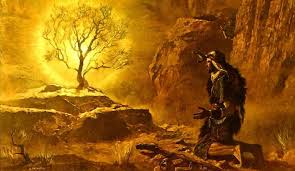
the Israelites go into the wilderness to "offer a pilgrim-feast to the Lord." At that point Moses led them on a daring dash for freedom, through the Red Sea and out into the wilderness in what appeared to be a charge into the open jaws of death. In this wilderness there was little water and no food, only hostile tribes and poisonous snakes. 


Midbar
"Wilderness" translates the Hebrew word, midbar, which is sometimes incorrectly translated as "desert."My Hebrew dictionary says that midbar means "tracts of land used for pasturing flocks and herds; uninhabited land." The word conveys the sense of a land that is still wide open space, un-surveyed, unmapped, undomesticated by humans. The wilderness is land that is still relatively free of human control. In Exodus theology the wilderness represented divine presence, lack of human control -- and freedom. 

In sharp contrast to the wilderness stood Egypt, which was very much under human control. In fact, the Egypt of the Pharaohs was famous for its order and neatness. So Egypt represented human rationality, human order -- and slavery. Thus in Israel's tradition the wilderness came to symbolize the unpredictable and unfathomable side of life, the mystery of God. This contrast between Egypt and the wilderness is crucial to a Christian view of troubled times. 

The Wilderness as "God's Country" 

We can use the word "wilderness" to refer to any and all of those difficult times we ourselves
experience, as well as the times when we are experiencing the pain of others second-hand as I have been this past week. To live in the wilderness means living in mystery, where things are beyond my understanding and my control; it is to live in "God's Country." 

There is another important dimension to the wilderness symbolism. In Hebrew thought, history is experienced as linear, not cyclical: it starts with creation and moves relentlessly toward its fulfillment. 

We individuals are born into that flow and are called to shape it by our decisions. We are moving onward with the flow of time toward the future. God gives us the future and we accept it from his hand. When Israel was called out of Egypt, she was also called out of the past and asked to move joyfully and trustingly into God's future. The wilderness, then, was not only a symbol of divine mystery but also a symbol of the future. Each of us is called, like the Israelites, into an unknown future; but if we don't know God's goodness or trust in God's love, we experience the future as a threat. On the other hand, if we trust in God's goodness and love, then the future is transformed from a threat into a promise. The wilderness as the unknown future is in a special sense God's preserve, it is par excellence "God's Country." 

So, if I had to say a word of comfort to any of the people I’ve been praying for, I’d probably say something like this: 

"I see that right now events in your life are completely beyond your control, and the future is unknown and terrifying; you are in the land of darkest mystery. Well, take off your shoes, because you are on holy ground. Welcome to the wilderness -- welcome to God's country! This is where the Lord is expecting to meet you and love you and deliver you." 

Let’s all pray for our brothers and sisters who find themselves victims of every mysterious kind of tragedy around the world, and any people who are right now wandering in a land of fearful mystery. May they experience the reassurance that comes from realizing that the trackless wasteland in which they find themselves is indeed God’s mysterious country, and that God fully intends to meet them there – and probably already has. 


Monday, January 6, 2025

THE JOURNEY


I first posted this reflection 11 years ago, but it still seems fresh.
In his second chapter the evangelist Matthew treats us to a charming story full of oriental color
and rich with mystery: the story of the wise men that follow a star in search of the infant Christ. We commemorate this story this Sunday on the feast of the Epiphany.

In celebrating this feast the church celebrates the belief that God has expressed and revealed himself totally in Christ. Christ is the “epiphany” (“showing forth”) of God. From now on we have a path to follow in our search for God: Christ.

The search for God is an adventure that starts very early in life, with our first steps as babies. St. Augustine says that we’re created for God and our hearts are restless until they rest in God. And so we find ourselves drawn to the journey, like the magi, following a star.

It’s a long voyage in which grace and human effort are mysteriously united. The star, we might say, is grace, God showing the path and offering us hope. The walking, the doubts and the questions, they’re all part of the human effort.

Seeking God can be a difficult journey at times, and it lasts our whole life. Sometimes the star gets hidden behind a layer of clouds, at other times we feel too tired to continue. Although the journey of the wise men is filled with a sense of gospel joy, it must have been a difficult one just the same. T.S. Eliot captures this difficult aspect in the first half of his poem, “The Journey of the Magi.”


A cold coming we had of it,
Just the worst time of the year
For a journey, and such a long journey:
The was deep and the weather sharp,
The very dead of winter.
And the camels galled, sore-footed, refractory,
Lying down in the melting snow.
There were times we regretted
The summer palaces on slopes, the terraces,
And the silken girls bringing sherbet.
Then the camel men cursing and grumbling
And running away, and wanting their liquor and women,
And the night-fires gong out, and the lack of shelters,
And the cities hostile and the towns unfriendly
And the villages dirty, and charging high prices.:
A hard time we had of it.
At the end we preferred to travel all night,
Sleeping in snatches,
With the voices singing in our ears, saying
That this was all folly.

May the Lord give us the strength to follow the star, and to help one another on the journey especially during difficult times, when the star is behind the clouds. Le me end with the second half of Eliot’s poem:

Then at dawn we came down to a temperate valley,
Wet, below the snow line, smelling of vegetation;
With a running stream and a water-mill beating the darkness,
And three trees on the low sky,
And an old white horse galloped away in the meadow.
Then we came to a tavern with vine-leaves over the lintel,
Six hands at an open door dicing for pieces of silver,
And feet kicking the empty wine-skins.
But there was no information, and so we continued
And arrived at evening, not a moment too soon
Finding the place; it was (you may say) satisfactory.
All this was a long time ago, I remember,
And I would do it again, but set down
This set down
This: were we lead all that way for
Birth or Death? There was a Birth, certainly,
We had evidence and no doubt. I have seen birth and death,
But had thought they were different; this Birth was
Hard and bitter agony for us, like Death, our death.
We returned to our places, these Kingdoms,
But no longer at ease here, in the old dispensation,
With an alien people clutching their gods.
I should be glad of another death.

Saturday, March 16, 2024

Not Yet!

My hour has not yet come
In the last sentence of this past Friday’s gospel passage, St. John tells us that the crowd in Jerusalem could not attack Jesus “because His hour had not yet come.”

He uses that phrase a couple of times in his gospel. First, we remember the scene at Cana when his mother asks him to solve the problem of the wine running out, and he explains “my hour has not yet come.”

Then, in verses skipped in the editing of Friday’s passage, from John Chapter 7, when “his brothers” encourage him to go up to Jerusalem, he replies “my time is not yet here;” and in the following verse he explains to them “I am not going up to this feast, because my time has not yet been fulfilled.” 

And then the verse in Friday’s gospel, “no one laid a hand upon him, because his hour had not yet come.”

In each of these passages, the same word shows up in the original Greek: oupo, a very common adverb meaning: “not yet.” 

As ordinary as the word  oupo, “not yet” may be, it is crucially important in all the passages we just heard: To say that the hour has NOT YET arrived indicates that eventually the hour WILL arrive.

It implies that Jesus' life is following the plan, but as of yet not all the stages of that plan have occurred. But they will. Christ’s earthly life is following a trajectory, heading in a single direction: it has significance, it has meaning.

And if that’s the case, then we who have Christ living in us and who are living in Christ, we are also living out that plan, following that same trajectory. This is especially important for you and me to remember when things are going badly. In times of pain and hopelessness we can hold onto that little word  oupo , “not yet,” that assures us that no matter what things may look like, our lives are heading in a certain meaningful direction, and therefore, everything in our lives has meaning, even and especially the seemingly bad parts.

Father, the hour has come
At the last supper, Jesus says, “Father, the hour has come, glorify, your son.” It is in his suffering and death that he finally reaches the hour, his goal: the Glory of the father. And we who have suffered with him will one day be glorified with him as well.

Each year during Holy Week and Easter, we celebrate the “hour,”  we remind ourselves how the story turns out:  Christ’s passion and death are oupo, not yet the end of the story. We know that the Easter mystery does not end on Good Friday: we live in the assurance that Sunday is coming.

The idea of oupo, “not yet” disappears early on Easter morning, when Christ is finally raised to a new life, and then in the ascension is brought to the fullness of glory at his Father's right hand. 

And we who are still suffering here in this vale of tears are on our way to join him there. It's just that our own hour of glory has not yet come. 

A final thought: Lots of times when when it seems that "God didn't answer your prayer," the Lord did in fact give an answer to your request -- the answer was oupo. 

Oupo -- Not yet!


Saturday, September 10, 2022

TIME FOR A NEW SCHEME

Earlier this week at mass St. Paul warned the Corinthians that "time is coming to an end" (1 Cor 7:29), and tells them to act accordingly: If you're single, don't get married, if you're married then stay that way, and don't get too wrapped up in the affairs of this world (1 Cor. 7:29-31)

Then comes the verse that has kept me reflecting this week: 

"For the world as we know it is passing away" (v 31).

The Greeks says "For the schema of this world is passing away." The Greek word schema means the external form or appearance. What is it, then, that's passing away? In our passage, schema doesn't refer to the physical form of the earth but to the way of life in the world. As one commentator notes, "The reference is primarily to culture rather than to physical form." So a more helpful translation might be something like "the way of life in this world is passing away."  

Lately it seems that our "world," which has banished God and the notion of Ultimate Meaning from the discussion, is showing signs of coming apart. In the material world which has substituted money, possessions, power and prestige for God, look at the amount of hatred that gets spewed every day into our cultural atmosphere, or the anger, violence and intolerance that crowd the front pages of our newspapers each day. Ask yourself, "How well is this schema of the present world working?" "Does it leave us with a sense of meaning and direction in our lives?" 

According to the schema of this present world I may be quite successful, with lots of money, popularity and material stuff (the very things that Paul tells us are passing away).

This schema-without-God, however, always leaves us in the end wishing for more. That's because we're made for more, so much more!

Jesus preached the arrival of a new schema, which he called "the Kingdom of God." This Kingdom has little to do with our possessions, our power or prestige. Rather it exists in the spaces between us, in our relationships with others. What characterizes those spaces, those relationships in my life? Is it control? Impatience? A sense  of superiority? These are not what the Kingdom is made of. The Kingdom of God, which will replace the schema of this world, is, of course, about Loving one another. "The Kingdom of God is among you, it exists in the spaces between you."

Did you ever stop to think that of all the virtues he could have preached, Jesus constantly stressed love of neighbor, and made it the one criterion for entry into the Kingdom? He was always teaching us about love because that is who God is, because that is what the Kingdom is. We are created in the image of God, a God who is Love, who is Intimate Relatedness (the mystery of the Trinity). So to the extent that we fall short of selfless vulnerability and self-sacrifice we're falling short of being our true selves, and are failing to build up the Kingdom here and now. 

So, if you act as a true follower of Jesus, as a member of the Kingdom, of this new schema that is breaking in on the world's present schema, expect to be seen as an oddball. In the 1970's the oddballs were called "countercultural" (civil rights protesters, draft card burners, hippies and so on). The New Testament gives us the blueprint of the new schema and invites us to live in a way that is "countercultural." You can easily fill in the content of this alternative schema, since you've been hearing it and reading it in the gospel your whole life. The Schema of the Kingdom of God will last forever, and will be around long after the sad schema of the present godless world has passed away. 

Our Father in heaven, may thy Schema come! 


Sunday, August 28, 2022

A TALE OF TWO BRIDGES

Bridge #1

Le pont de l'Europe

The Pont de 'l'Europe was built in 1975 to carry the traffic of the national highway N100 across the Rhône River at Avignon in southern France. As I drove across it on my way to visit the Palace of the Popes, I glanced to my left to catch a glimpse of a far more famous bridge. This second one, although famous, is disappointing in this: it ends partway across the river!

Bridge #2

This second brdge has been made famous because of the charming children's song called Sur le Pont d'Avignon ("On the Bridge of Avignon") written in the mid-1800's.

Also known as le Pont Saint-Bénézet , the Pont d'Avignon was a medieval wooden bridge constructed between 1177 and 1185. It was soon replaced by a stone one composed of 22 arches, an engineering feat 900 meters long. Because of the frequent powerful floods that came down the Rhône, the bridge was in constant need of repair as various arches would collapse and fall into the river. The task of constant repairs became more and more burdensome until by the 1600's the bridge was abandoned, and its arches were dismantled or simply allowed to wash away until today only four of those twenty-two arches are left. And this is the "bridge" that the children sing about in the song.

Learning from the bridges

St. Monica
The remaining four arches hold a powerful lesson when compared to the sleek bridge of the N100 nearby.The contrast is perfect for the celebration of today's feast of Saint Monica, the mother of Saint Augustine of Hippo. She was a peasant woman whose Christian faith was so deep and strong that her unceasing prayers for the conversion of her son were finally answered, giving the Church one of her greatest thinkers and theologians.

Her unwavering faith was like the Pont de l'Europe, reaching, as it were, all the way to the Lord in heaven. Meanwhile her brilliant but wayward son was, so to speak, wandering lost on the old Pont d'Avignon, using only his intellect to get to Ultimate Truth. 

Finally, thanks to Monica's prayerful tears, he received the grace of conversion. Gradually he began to seethat the bridge he was on could never get him to where he so desperately desired to go, because it stops in midstream. He would later write, "You have made us for yourself, O Lord, and our heart is restless until it rests in you." 

It seems that millions of people today are stuck, like Augustine was, on the bridge to nowhere. Their hearts are restless, and they keep seeking for Ultimate happiness and meaning in the material world, and exclude God from the picture. Given all these people wandering on the bridge that can't take them anywhere, the catastrophic results we see around us are not surprising. 

Let us pray to Saint Monica and her son that more and more of our brothers and sisters may be given the gift of conversion and so come to faith in God in whom alone their hearts can find rest.

Saints Monica and Augustine, pray for us!


Saturday, January 29, 2022

ASKING THE RIGHT QUESTIONS


ASK THE COMPUTER

In the mid-1970's I learned a computer language called "Basic," and under the tutelage of Fr. Mark, a brother monk, I learned to program our computer to do all sorts of handy things for me in my work at school. I loved the thrill of getting the computer to follow my directions and, say, make a list of all the students who had signed up for Geometry but had received an F on Algebra I the previous semester. 

It was even more fun, in a weird sort of way, it the program didn't work at first. Say I type "Run" and the computer screen fills up with a single student's name appearing over and over. Uh-oh! Now what? I type "Break." The first step is to ask the computer what's going on. I ask it to tell me the value of each of the variables I've assigned at the top of the program. Let's say I ask for the current value of the variable SN$(%), that increases by 1 each time a name is printed.  Whoa! The value of SN$(%), which should be over 50 by now, is still at 0! That's the explanation of the weird output. (I love explanations, don't you?) So then I go into my program and make the necessary change, and type "Run" again and see how much further I get toward producing the list. Asking the computer makes perfect sense because I know that the answer, the logical explanation, is there somewhere -- I just need to ask the right question.

"REASON" TAKES OVER

In the 1700's in Europe, the rationalists saw that everything in the world seemed to obey the laws of the sciences that were being developed at the time. They decided that the universe was a vast mechanical system governed by the laws of the physical sciences. Having applied the laws of evidence, cause and effect and so on in the physical world with such astounding success, they couldn't stop themselves, and began applying these laws to everything, even things that lay outside of their neat time-space box. They concluded that if something couldn't be measured scientifically then it simply didn't exist. They just decided this, of course, with (paradoxically) no evidence for their claim. So, out the window went ultimate meaning in life, God, existence beyond the grave, and all such non-scientific religious concepts.

THE GOD OF EXPLANATION

Up until that time people had believed in a transcendent God -- the God of Abraham, Isaac and Jacob, for example. The Judeo-Christian God was involved with His people, and loved them, while they in return could praise, thank, glorify and even complain loudly to their God. But now suddenly the rationalist worldview swept over the Western World, and the God of Abraham was replaced by "the god of explanation." You and I sometimes fall into this mistake, too: We ask God to explain himself to us, to justify why a certain tragic thing has happened. "If you are all loving and infinitely kind and just, then why was this baby born with this awful disease? Explain yourself!" We think it's like asking the computer until you get the rational solution to the question. And naturally we get frustrated, angry and feel betrayed when no explanation is forthcoming.

WANTING IT BOTH WAYS

Why do we people of faith sometimes get angry at God for not offering us explanations for the existence of evil in the world? Well, we seem to want two mutually contradictory things at the same time: We want a God who operates in a rational, logical manner (like my computer program), a God that we can comprehend -- a God like us, whom we can therefore predict and even control. But at the same time we want a God who is infinitely loving and forgiving, and whose power and wisdom lie way beyond the limits of our puny human understanding.


The God of Faith permeates the world God created, with its incredible beauty and elegance. But this same God invites us into a relationship of intimacy that involves vulnerability, s[spontaneity and trust. inviting you and me to rely on the virtue of hope in the face of the more mysterious parts of the Divine Plan. The God of Faith does not, indeed can not offer us explanations for the most important things in our lives. That's why the God of Faith apologizes to us (see last week's post): God created us to be curious problem-solvers, but then came up with a Plan for the world that is beyond our ability to comprehend. What a bummer! 

But also, what an opportunity for a relationship of intimacy and trust between ourselves and God!  


Saturday, October 23, 2021

BACK TALK


I was sitting there in front of the blessed sacrament at 5:30 this morning with my back aching, as usual. ('ve started going to specialists for the condition because the pain and discomfort are really intruding into my daily life.) I picked up the gospel passage for Sunday, Oct. 24 is Mark 10:46-52, the story of the healing of the blind man, Bartimaeus, and began looking for a verse to meditate on.

You remember that in the story Bartimaeus keeps crying out to Jesus, "Helpme!" Jesus, hearing his cry for help, stops and asks that his apostles bring Bartimaeus over to him. The next verse caught my attention. The apostles say to the blind man, "Take courage, get up, Jesus is calling you." With my lumbar spine competing for my attention, I reread those words "Take courage, Jesus is calling you."    

I decided to invite my spine into the conversation, and asked what this pain can contribute to my meditation. My lumbar spine answered immediately, "Don't you get it? This morning Jesus is telling you to have courage, because through this pain he's calling to you. He must have something to say to you."

True, I have been reflecting a lot recently on the mystery of suffering. and on the Christian's belief that suffering is at the very heart of our faith, that thanks to the Cross of Christ, it has meaning, it's bound up with God's infinite, tender love for us. So, this morning that belief was being "road-tested," you could say. So, as I shifted and twisted in my chair, I let myself hear the apostles' words directed to me: "Take courage, through your pain Jesus is calling you!" 

It was Jesus' very personal way of addressing me in my discomfort. He seemed to be inviting me to see my little bit of suffering as a share of the suffering of my brothers and sister around the globe who are really suffering.

He seemed, next, to be inviting me to lift my gaze slightly from the monstrance containing the sacred Host of the Blessed Sacrament, so as to gaze on his broken, crucified body hanging on the cross in the sanctuary. He seemed to be saying, "Take courage. Trust me, all of this suffering really does make sense." Spoken from the cross, these words had a lot more impact on me.

Rabin Mondal Genocide (1972) Oil on canvas 

I sensed that the Lord had indeed called me over to hear his words of encouragement this morning. And even as I shifted once more in my chair I could feel his healing hand on my heart. On my lumbar spine? Not so much.

Saturday, July 17, 2021

A GOD TOO SMALL

For my lectio this morning I spent time with the sentence "[Jesus'] heart was moved with pity for them." As I put myself in the scene, and felt Jesus wrap his arms around me the way a shepherd might a little lamb, I started to notice a familiar disconnect. I've been confronting it more intensely recently in various books I happen to be reading. I'll try to unpack at least some of what I've been wrestling with.

Forty years ago J.B. Philips wrote a book with the catchy title "Your God is Too Small." Although I didn't read the book, I've never forgotten the title. It's only very recently that I've started to realize that the challenge in that title is not addressed just to others but to me. My God seems to be getting smaller every day! Here are two indicators that I've been faced with in the past few days: 

- The great Catholic theologian Karl Rahner reminds me that "God" cannot be thought of as one more object within my perceived world, alongside everything else in creation. The idea of "God" has to go beyond (transcend) the limits not just of my senses, but even of my limited intellect. Jesus took on flesh and dwelt among us to bring this transcendent God within our experience, revealing something of God's inner mysterious Trinitarian life of Love. But the mystery of God still remains too big for me to simply latch on to. Beware of people who have God in their pocket!


The God of Moralism at work

-- The Franciscan Richard Rohr keeps throwing down various versions of a certain challenge all the time. Most recently I came across it in his "Immortal Diamond." Religion, he contends, always makes God into an object of some kind, and reduces God to the role of manager of a great System of rewards and punishments. "Moralism" offers you the goal of heaven if you obey the rules scrupulously. From the perspective of "moralism" God's love and compassion revealed by Jesus are suddenly restricted to a few people who follow the moral formula. As for the rest of humanity, well, sorry, Jesus, but they don't qualify. The system of "moralism" seems to be what religion has usually been reduced to. What, then, becomes of the Jesus of the gospel whose heart is moved with pity at the sight of all the tired and hungry people who are like sheep without a shepherd? 

Is this a perfect caterpillar? 
Jesus doesn't call me to moralistic perfection but rather to transformation, Transformation means letting go of my individualistic project of earning my way to heaven by following rules and measuring up to various minimum standards. The "Good News" that's presented from the pulpit is almost always from the perspective of "moralistic" religion supervised by a God who calculates and measures everyone's worthiness or unworthiness. Do I dare to push back and object that this God is way too small! Again, where is the Jesus of the Gospel?  

Only seldom do we hear about the foreboding challenge of "transformative" religion as opposed to "moralistic" religion. One big stumbling block to "transformative" religion is that the latter requires me to let go of my comfortable well-understood God. The total letting go required by transformative religion requires complete trust in a mysterious God who loves me and everyone unconditionally and infinitely and intimately. A God who does not follow our human rules. Most of us have never been invited by the Church to a personal intimate friendship with God, a friendship that can ultimately transform us into someone totally new.

Instead we are presented with at God who is way too small for that kind of intimacy: a God whomeasures, who gets even with people who screw up, who is concerned about the rules being followed. so that no one unworthy can share in the Eternal Reward that is due only to those who merit it. This is a human-scale God, a God who is way, way too small. No wonder so many good people are no longer interested in dealing with such a God.


Because of time constraints, let me leave the problem hanging here for a week, if you don't mind.

Meanwhile, try praying with the scriptures and receiving the Eucharist and encountering others with the idea of encountering a mysterious loving God who is incredibly bigger than the one you may be familiar with and are comfortable doing business with.

The God of Transformation at Work


Saturday, July 10, 2021

WAIT! I HAVE A PLAN!

Authors of "thrillers" love to use this sort of crucial turning point in the plot: 

The four friends are exploring a deep, dark cavern armed only with knapsacks, flashlights and canteens. Suddenly  there's an earthquake that causes the surrounding tunnels to collapse. The four are safe for the moment in this large room; but after a thorough search reveals no exit tunnels they realize that they're hopelessly trapped. [Skip the dialogue here and the closeups of terrified faces, and cut to the scene some time later as all are lying around the floor of the cave, each lost in his or her own thoughts] 

Suddenly our hero stands up and starts rummaging through his knapsack.

"What are you doing?" a sleepy voice asks. Without looking up, he announces in a businesslike tone,

"I have a plan!"

"I HAVE A PLAN"

Dr. King's famous words "I have a dream" continue to inspire millions of people around the world, including me. But there's something just as thrilling when in the midst of a situation from which there seems to be no escape, and everyone has given up hope, the hero confidently announces, "I have a plan." Yes! Just when it seems that all is lost, the plot takes on a whole new dynamism, a fresh start. The story can now proceed -- and with a more interesting story line.

Today so many people rely solely on their senses and rational thinking to find the meaning in their lives. Unfortunately, the really important things such as the ultimate meaning and purpose of our existence don't show up on any measuring devices, and escape the entire array of  marvelous detectors in the physics lab. Speaking of physics labs, our Fr. Mark Payne, O.S.B., who died six years ago today, used to have a  sign posted in his physics lab:

"If you cannot measure it, it's not physics.

If you can measure it, it's not ultimately important"

Searching for answers in Surfside

There's the problem in a nutshell: We are are made for meaning, we want and need to know the ultimate significance of things, the gist, the plot of the story, of our story. When certain folks tell us that there is nothing beyond our material world, that there is therefore no larger plot, no gist, no ultimate meaning, we may be able to live with that for awhile, provided we can stop our minds from asking the very questions it needs most to ask. But when the roof of the cavern caves in, or the condo collapses, or you're told that you have COVID, your mind just naturally kicks back in and asks "Why?" 

Of course, people of faith know that in situations of suffering and catastrophe, we don't usually get nice clean answers when we ask "Why?" But the first reading in today’s mass (Genesis Ch. 50) assigned for July 10, shows Joseph in Egypt revealing his identity to his brothers who many years ago had sold him into slavery. The brothers are now worried that Joseph will avenge himself on them. Here’s the dialog. The brothers start pleading with Joseph:

"Please, therefore, forgive the crime that we,
Joseph forgives his brothers
 the servants of your father’s God, committed.”
When they spoke these words to him, Joseph broke into tears.
Then his brothers proceeded to fling themselves down before him and said, “Let us be your slaves!” But Joseph replied to them:“Have no fear.  Can I take the place of God? Even though you meant harm to me, God meant it for good, to achieve his present end, the survival of many people. Therefore have no fear. I will provide for you and for your children.”

Joseph clearly had figured out that the terrible experiences of being sold into slavery by members of his own family had some deeper meaning. "Even though you meant harm to me, God meant it for good,
to achieve his present end, the survival of many people." His attitude of trusting that God's loving plan was at work in his life is a gift that all of us pray for. 

Joseph, however, received a truly rare gift: a sense of what God's plan actually was.(Namely, "the survival of many people"). Most of have to walk by faith and not by sight, taking it on faith that in God's overall loving plan for the world, everything, including suffering and evil ultimately works for the good in the end. 

I'm sure that Jesus must have a special, warm place in his heart for people who are so overwhelmed by grief or anger that they cannot see how God could allow such a terrible thing to happen and consequently they no longer believe in God, and look someplace else for meaning.

Meanwhile, as we pray for people who see no meaning in their lives, we should also praise and thank the Lord for allowing us to believe his consoling voice when it whispers to us, "Do not be afraid: I have a plan!"  

Photo from Hubble telescope: A star "swarm" by the One with the Plan


Saturday, January 2, 2021

EMMANUEL IN THE PANDEMIC

It seems that everyone was happy to say good bye to 2020 and move on in hopes that 2021 will be better. I guess that to a lot of people it must seem that in 2020 the world slipped beyond God's grasp and is now tumbling in a free fall towards chaos.   

Early this morning (Saturday, Jan. 2, 2021) as I sat in church I opened to the first reading for today's (Saturday's) mass, from the First Letter of John 2:22-28.  I couldn't help noticing that in the space of five verses one word is repeated six times: the verb "remain," which is one of John's favorite words. In Greek, μένω ménō (men'-o) means "to stay, remain, abide". It is often used to describe the deep, intimate and mysterious mutual indwelling of the Father, Son and Holy Spirit. In this morning's passage, however, it's used to describe how the Word remains in us and we remain "in the Son and in the Father." 

When I saw this passage I immediately thought of another aspect of the word, namely "to remain permanently, to abide." The Word became incarnate for us and "abides" with us forever. "Emmanuel, God is with us" describes a condition that will last for eternity, not just for the Christmas season.

So, how does this rich verb help us to reflect on the pandemic? Here's what occurred to me: God abides with us and with all of creation, no matter how chaotic, how painful and absurd everything looks to us with our limited intellects. It takes courageous faith the keep insisting the God is somehow still in control of the world, and that God's loving plan for the world is moving forward every day. 

Some of New York's 45 mobile morgues
Emmanuel is with us walking in the corridors if the ICUs, and among the refrigerated trailers filled with corpses of Covid 19 victims for whom there is no longer room in the morgues. Emmanuel. God-with-us, is not only present with us, but comes in mystery "with healing in his wings" to encourage us, to lift us up, to give us the strength and energy to keep moving on. 

The year 2020 was filled, like any other year, with the healing presence of God's love for you and me and all of humanity, indeed of all creation. It's just that 2020 demanded, it would seem, a lot more trust in God's unfailing goodness and infinite love. And we don't do too well with things "infinite" and "mysterious." So, there's one good aspect of the year 2020: It gave us plenty of exercise in the virtues of Faith, Hope and of course Charity toward one another.

May the new year of 2021 offer us many more such opportunities, but maybe in ways that are easier for us humans to understand.

O come, Emmanuel!

Saturday, August 1, 2020

NO SURPRISES, PLEASE!

.
This past Thursday the lectionary invited us to reflect on this well-known episode on Jesus' life:

Jesus came to his native place and taught the people in their synagogue.
They were astonished and said,
“Where did this man get such wisdom and mighty deeds?
Is he not the carpenter’s son?
Is not his mother named Mary
and his brothers James, Joseph, Simon, and Judas?
Are not his sisters all with us?
Where did this man get all this?”
And they took offense at him. (Mt 13:54-56)

The first thought that usually comes to mind as I read this passage is always the "scandal of familiarity," the notion that we tend to assume we already know everything about a particular person and have them captured securely in one or another box. So when Jesus performs miracles and preaches in ways that move people's hearts like never before, his townspeople can't figure it out because it doesn't fit their preconceptions of this man whom they've know for all these years and whose relatives still live among them. And since Jesus' behavior doesn't fit their preconception of the "carpenter's son" they take offense at him.

That's probably pretty close to what the gospel writer had in mind when he recorded the story. But I'd like to suggest a slightly different take that might make for a more profitable meditation for us who are hunkered down trying to hide from the covid-19 virus.

See if you agree with this thought from cultural anthropologists: the role of most religions is often to make sure that nothing changes. For millennia people have been sacrificing to their gods to make sure that the crops grow as usual, that the spring rains return as they're supposed to, that they and their families can live out their lives in peace. 

This seems to reflect our built-in preference for predictability (which means the ability to control things around us) and for understanding (figuring out the meaning of things on various levels). We don't like living with mystery, with events that lie beyond the reach of our senses and our intellect. To say that something is a mystery is to admit that we can't control it.

Now, back to the incident of Jesus in his hometown. The townspeople have been hearing about Jesus' miracles and now hear for themselves his incredibly powerful preaching. Their first reaction is to be "astonished"by Jesus' power, but their astonishment quickly turns to resentment and hostility. Why? Because they find themselves confronted with something that they cannot understand. God is doing something new in their midst, but instead of rejoicing and glorifying the Lord because if it, they feel threatened.

God is saying through Jesus "Behold, I am doing something new (Isaiah 43:19)!" An encounter with Jesus is an encounter with mystery. The incarnation, when you think about it, is incomprehensible: The infinite becomes finite, the Totally Other comes among us as a little baby, the Lord and Creator of the universe walks around Galilee as a simple rabbi. "Incomprehensible" is right!

Christians believe that this incomprehensible mystery is still going on at all times in every person, in every created thing and in every corner of the universe. Because of the incarnation, "God comes to us as our life," in every event great or small, pleasant or unpleasant, joyful or frightful. 

So, when God comes to us as covid-19, what is our prayer? Maybe it could be "Lord, take care of your people, keep us healthy and safe, and let us not lose hope in your loving care." Behind our prayer, whatever it might be on a particular day, is the underlying faith that God loves each of us infinitely and absolutely, and that everything is under God's control and God in Jesus Christ is in our midst to love and to save, to bring to the entire world healing and peace. 

"Behold, I am doing something new. Wear your mask!"