Showing posts with label Death-Funeral. Show all posts

Saturday, October 28, 2023

Preparing for Death

Earlier this week a good friend texted me to tell me that her 81 year-old mother had just asked her "How do you prepare for death?" Since I'm good friends with both of them, I figured that I'd write a response even though no one had asked me to. Below is the letter I wrote to the mom who had asked the question.


Dear Mrs. ___________,


A few days ago your daughter passed on to me a question that you had asked her, about how a person prepares for death. Naturally, at age 81 you and I start to think seriously about this question. So, I thought I would share with you some of my thoughts about preparing for death.


First, I try to remember that, as Jesus says in one of his parables, we really spend our whole lives in expectation that the Lord will come “at an hour we least expect.“ In one parable, he says that if the master returns and finds the servant doing what the master had asked him to do, then the servant will be rewarded. So one way for me to prepare for death is to just live my life following Jesus’ example and his commands: loving all those that God puts in my life every day. If I d0 that, then I’ll be prepared whenever the Master decides to come.


I’m finding that there is also a more immediate preparation for death. All of the saints seem to refer to their relationship to the Lord as “friendship,” as a close, intimate relationship with the Lord. This isn’t based on just “saying prayers,“ but on having back-and-forth conversations with him in which I let him know my inmost hopes and fears, my pains and my pleasures. Of course he knows these already, but I’m telling them to him because this is what you do in a close friendship: you leave yourself vulnerable and open to the beloved’s responses. It builds a closer relationship with the Lord.

I’m preparing for death, too, by trying to become aware of all the ways in which the Lord

communicates with me every day: in a beautiful sunset, for instance, or in a kind deed someone does for me, or in a verse of Scripture that touches my heart in a special way. God is always communicating with me, so I’m trying to get better at watching for his loving actions in my life.

It’s also important for me to be careful of my idea of God. Jesus came to reveal to us that God is a “father“ who loves me unconditionally just the way I am. He is not the vengeful, spiteful executioner, who seems determined to keep people out of heaven. Unfortunately, many of us have been introduced to that God, so it takes effort to get rid of that idea, and replace it with Jesus’s idea of God as an all-loving Father, like the father in the parable of the Prodigal Son. That is, after all, the God that Jesus came to reveal to us. 

So, as I start to prepare for death, I am preparing to meet this God, who loves me infinitely, and who has been giving me gifts every day of my life, a God who can’t wait to meet me face to face, and so I am starting to look forward to meeting him as well. 

Well, these are just a few of my own personal answers to your question. Let us keep praying for one another as we try to get ready!

Love,

Fr. Albert


Saturday, March 6, 2021

KINDERGARTEN LESSON

     To be honest, I'm not looking forward to writing this post. In the past ten days or so I've been going to funerals and interments and memorial masses, and reading emails about people dying. These were all people whom I considered friends, some of them close friends, all of them age-mates and a couple of classmates from grammar school or high school. This number went way beyond the superstition that deaths come in threes. Maybe sevens? 

These days have been filled with bereaved spouses, weeping grandchildren, sad relatives, somber friends and bagpipers.  After I return from a funeral mass on Thursday my guardian angel guides me past the kindergarten classroom. I peek in and see that they're beginning a new activity. The teacher sees me and motions me to step in (as I do once or twice a week). 


"Good afternoon Father Albert. God bless you!"  

"Good afternoon, children! It's so good to see you!" I have to imagine their smiles, since all of us are wearing our masks.

On the SmartBoard is written "I want to go to ..." and each child has a sheet of wide-lined paper with those same words copied more or less legibly on the top line. 

The teacher asks, "Who would like to start? If you could go any place in the world, where would you go?" I immediately think of so many places I would love to go. I settle on New Zealand.

Hands go up in different corners of the socially distanced room. 

"Natasha? Where do you want to go?"

"The park."

"Okay! Very good! Let me write that up here on the board. Who's next? Marvin? 

"I want to go to my brother's house."

"Good! Remember, now, anywhere in the world. Kayla?"

I'm waiting for some choices that are a little more exotic. 

"Shop Rite." 

Then it dawns on me that the experiential world of a kindergartner from a poorer neighborhood starts out pretty narrow. The park, my brother's house, the supermarket. As I stand there with my visions of New Zealand and the rusty rocky surface of Mars, I start to see a connection between the narrow view of the world of many of these little kids and the funerals I've been attending: You might call it tunnel vision. 

What if you believe that what you see and experience in this present world is all that you get? What if there's nothing more after you die? This is tunnel vision, in which you miss the really important stuff, the whole meaning of your existence. And all you can see is the Shop Rite. 

All of the grieving spouses of the people whose deaths I've heard about in the past couple of weeks have something in common: They all believe in the resurrection. Even in the midst of the agony of grieving, there is that unspoken underlying faith that they will be reunited with their loved one someday, and that he or she is in fact present to us even now in a new and different way. 

The church's prayers for the ceremonies at wakes, funerals and burials express this faith beautifully, even if the mourners don't have the words themselves at the time. I'm thankful every time I hear these prayers, especially if I'm the one praying them aloud for the assembly.

The ceremony starts with the greeting of the body at the door of the church at the beginning of the funeral, when the celebrant sprinkles the casket with holy water and says: 

With this water we call to mind N’s baptism. As Christ went through the deep waters of death for us, so may he bring N to the fullness of resurrection and life with all the redeemed.

Then the ceremonies end when the funeral procession arrives at the cemetery and the minister prays: Our sister N. has gone to her rest in the peace of Christ. May the Lord now welcome her to the table of God’s children in heaven. With faith and hope in eternal life, let us assist her with our prayers. Let us pray to the Lord also for ourselves. May we who mourn be reunited one day with N.; together may we meet Christ Jesus when he who is our life appears in glory.

From beginning to end, then, the Catholic funeral rites encourage and console us with the infinitely wide vision of the resurrection that we will all one day share with the risen Lord. We need to rely on that hope, and not let our grief narrow our vision to this world and to our overwhelming grief and pain. 

"I lift up my eyes to the mountains" (Psalm 121)  -- way, way beyond the park or the Shop Rite.


Saturday, February 1, 2020

SOUNDS LIKE A PLAN?

+

Every February 2 the Church celebrates the feast of the Presentation of the Lord, when Mary and  Joseph go to the temple in Jerusalem to offer the prescribed sacrifices required at the birth of a firstborn son. (Luke's account is the assigned gospel reading for the feast.) The incident is filled with symbolism and the fulfilment of prophecies. 

You may remember my previous post, referring to the grieving that our school community has been doing in the past couple of weeks because of the deaths of two teachers. My meditation on the feast of the Presentation this year has been colored, naturally, by that undercurrent of mourning. But the reflections can be of help to any Christian, I think. Here are some of the ideas that came to me.

A central figure in the presentation scene is an old man named Simeon who had been promised that he would live to see the Messiah. He took the infant in his arms and thanked God for fulfilling His promise. And he says to Mary,  

“Behold, this child is destined
for the fall and rise of many in Israel,
and to be a sign that will be contradicted
--and you yourself a sword will pierce--
so that the thoughts of many hearts may be revealed.”

This is a literary device that Luke is fond of, called a "programmatic prophecy," in which the speaker foretells how the story is going to unfold. I was thinking about the idea of "programmatic prophecy" this morning. It is based on a couple of fundamental assumptions: God has a plan for the world, this plan is ultimately about God's infinite love for the world, and thirdly, that loving plan is unfolding all the time, despite what it may look like to us humans.

The other central figure in the scene of the Presentation is Mary. She's really important to my reflections this year. Here's why: Two of our teachers dying within two weeks of one another doesn't sound like much of a plan to me. But sometimes we're faced, as Mary was, with deep, painful mysteries (--and you yourself a sword will pierce--) that are way beyond our intellect's ability to sort out logically. The gospel tells us that Mary kept pondering these things in her heart. Notice, not in her head, but her heart. We mustn't let the mystery of evil draw us up onto some high level of abstraction, because the Plan is invisible to the intellect, it won't yield to logical analysis. Mary humanizes the issue for us, and invites us to follow her lead by reflecting in our hearts with quiet confidence that the Lord is constantly loving and supporting us. There's an ancient litany of the Virgin Mary that includes the petition: "Mary, who kept the faith on Holy Saturday, Pray for us."


We all know people who have been so overwhelmed by the absurdity of some tragic event that they simply stop believing that there is a plan at all. For some mysterious reason,  they do not yet have the gift of Faith (or, more technically, the virtue of Hope, which allows us to hold on to our confidence in God despite the horrors and evils of this world).

This week I've been saying to the Lord, "I'm sorry, Lord, but this sure doesn't look like much of a plan to me. Or if it is a plan, it seems like a cruel one." And Jesus, who knows our human frailty firsthand, agrees: "Yes. I know just what you mean! I don't blame you for feeling that way. But I promise to help you to hang in there despite how terrible things seem. Try repeating the words I spoke to my Heavenly Father in the garden of Gethsemane, 'Not my plan but yours be done!'" 

I'm asking the Virgin to intercede for me and for our entire community, that her son, our Lord, will indeed stand by each of us, young and old, as we work our way together through the mystery of the Hidden Plan.

(But, to be honest, I confess that it still doesn't look like much of a plan to me right now.)

Saturday, January 25, 2020

ARE YOU THE ONE?.

.

This past week started with a death. When I arrived at the Benedictine sisters' priory of St. Walburga in Elizabeth to say morning mass, I was greeted with the news that their beloved Sister Damien had died just a couple of hours before at the age of 101. There was a thoughtful sobriety about the convent that morning.


Then, Thursday was the first anniversary of the death of my brother, Richard. So, I was preparing myself for a day of quiet remembering of this wonderful "big brother" who had been such a great influence in my early life. But my reflecting on his anniversary was cut short when it was announced to the school community that 58-year-old Bill Petrick, our Freshman English teacher, had died suddenly on the way to school that morning. 


It was just a couple of weeks ago that a 28-year-old History teacher had succumbed to cancer. Grief was piling up on our community. We tried to take care of the kids as best we could by inviting them to visit the counselling center, and by inviting them to talk frankly about the experience in many of our classes.


In class on Friday morning, I told my sophomores how rotten I was feeling over these deaths. When I asked them if they thought it was okay for a priest-monk to feel so sad about friends or loved ones dying, at least one student answered immediately that no, priests aren't supposed to feel sad when people die. I straightened him out fast, believe me, explaining that grieving is a very human and healthy thing, as Jesus and lots of saints have always insisted.

SO WHAT?

Of course, the mystery of death is way deeper than our human intellect's ability to fathom; but we still want to look for some shape, some sense in the face of any tragedy. As I was talking to my sophomores about our various experiences of grieving and our attitudes toward death, I thought of an incident that had given me a little perspective on my grief a year ago, so I shared it with them. I think it's worth sharing with you here.


I'm sitting in the funeral parlor at my brother's wake, when along comes my four-year-old grand-niece Gracie. She stops in front of me and stares inquisitively for a moment or two. She knows that she's seen me a few times before at family gatherings. Unfortunately, though, she hasn't had the chance to get to know me, and even less of a chance to know her other great-uncle, my deceased brother. 

As she stands and stares inquisitively at me, I can tell she's preparing to ask one of those questions that four-year-olds are so good at. Finally she asks me,

"Are you the one who died?"


ARE YOU THE ONE?


Luckily, I know the answer to this one right away: "No, Gracie. The one who died is uncle Dick. I'm uncle Albert." I keep a straight face the whole time, I'm proud to say.


Over time, though, her question has kept coming back to me as an Easter question: Am I not supposed to die every day with Christ so as to rise again with him in his victory over death and sin?

Each night in my examination of conscience I ought to be asking myself, When did I die today? Did I take every opportunity offered me to die to myself so as to live with Christ? For example, did some student in need ask me to die a little to myself by going out of my way to help him? Did I overcome a temptation, say, to cut short my prayer time and instead die to my own desires in order to "waste" some more time with the Lord?

Gracie's question is a haunting help to me every day: "Are you the one who died?"

With the Lord's help, I hope that I can answer her, "Well, Gracie, I'm working on it."

Saturday, February 2, 2019

ETERNAL TRAJECTORY

+
On Monday, January 28, I celebrated the funeral mass of my 86 year-old brother Richard ("Dick"), and preached the homily. I've decided to post my notes form that sermon, hoping that there might be a useful thought or two in there for you.

Screen writers often talk about a character's "trajectory," the movement or development of someone's life and character over a specific time period, the "plot" of someone's life. I want to reflect this morning on the trajectory of my brother's life. For me, it starts with his role as "big brother" to us three younger siblings. He was ten years older than me, and was always the model of a big brother. When I describe what he was like as a teenager, you'll recognize the Dick Holtz that you all knew as an adult. He was patient with us who were often underfoot, he was generous with his time, he was consistent, someone you could always count on, and very important for me, he was kind to us.

Then the trajectory of his life continued with his marriage to Joan, and from then on he was part of a partnership: "Dick-'n-Joan" became a single word, reflecting the loving union that lasted for the next 62 years. Then he took on the role of father to his children, Bill and Nancy. I remember watching him relate with his young children and realized that he had learned lots of parenting skills by dealing with my brother, my sister and me. 


His career as a mechanical engineer working for "Mother Alcoa" took him and his family from New Jersey to Australia, Indiana, Wales and Lebanon Pennsylvania before landing him here at the home office in Pittsburgh. From here, especially after his retirement, he and Joan would happily drive to Massachusetts or Connecticut or New Jersey to visit grandchildren and other family members.

Then his life's trajectory took an unexpected turn with the onset of medical problems such as bypass surgery and kidney transplants. Ultimately he went on dialysis, which meant the end of those trips to see his grandchildren. The last ten years of his life were spend on dialysis, and he became progressively more and more frail with the passing of the years.

But be careful! Don't picture the trajectory of his life at that point as heading downward. No, that would be to miss the whole point. To help you see what I mean, let's turn to this morning's scripture readings.

Road to Emmaus - Rouault
The gospel passage told the story of the two disciples on Easter morning walking home to their village, completely discouraged because they had hoped that Jesus was the one that would deliver Israel. You remember that suddenly Jesus appears, walking along beside them.For the next seven miles he talks with them, explaining all the Old Testament prophecies that show that the messiah must suffer. Remember that the passion accounts in the gospels were written to console and encourage Christians who were being persecuted and even killed at the time. This story of Jesus's teaching on  the road to Emmaus would have been of real comfort to the first readers of Luke's gospel, as they identified their own sufferings with those of their suffering messiah.  

A pastor in the Midwest had renovated the sanctuary of his church, and had replaced the huge crucifix that portrayed Jesus hanging in agony on the cross. He asked the contractor what to do with the lovely old crucifix. "There must be some church that could use this beautiful carved crucifix," he said. "We should be able to sell it to someone." The contractor, a specialist in church renovations, shook his head. "Sorry, father, I'm afraid not. You see, there's no market for a suffering Jesus."

Those two disciples on the road were not in the market for a suffering messiah that morning, and so they had been totally discouraged at the fate of Jesus: they had watched the trajectory of Christ's life take a nosedive into failure.

Our first reading, from Ecclesiastes, speaks of there being a time for everything: a time to be born and a time to die, and so on. But underlying that text is the worldview that everything under the sun is ultimately futile and serves no real purpose. That reflects the crucial fact that when that Old Testament text was written there was as yet no Christ: Jesus had not yet come into the world to show us that our lives, even the tedium and suffering, have ultimate meaning.

The central insight of Christianity is this: suffering is at the center of the plot; it is not some embarrassing interruption of God's plan, but rather is somehow, mysteriously, at the very center of the plot. That's why the crucifix is so important to our spirituality and our devotion and our liturgy: it reminds us that our lives and even our deaths have a meaning.

Jesus, the Son of God, became one of us precisely to take on himself all of our human weaknesses,  sufferings, dialysis and even death. He came to grips with death itself and, in a wonderful, mysterious turn of events, he won! His love conquered even death itself. His love for us forever turned to trajectory of our human lives upside down! Our suffering has now become the means of our salvation, our defeat is turned into victory, and our death becomes life eternal.

To return to my brother. As his earthly trajectory entered a new and final phase with dialysis and increasing disability, his wife Joan walked with him every step of the way: "Dick-'n-Joan" was still a single word. The suffering Jesus became a close friend of Dick's, walking with him on the road home. One day a couple of years ago as he and I were about to end a phone call, he said to me, "I love you!"

I was touched and delighted at the words that would become our ritual and the end of every phone call: "I love you!" He had come to see, perhaps, in the final phase of his earthly life, that it really is all about love. We, even as we mourn here this morning, can look at Dick's life and see the trajectory that he lived: It was all about love. His trajectory was always upward, ever upward, and has taken him onward, ahead of us to where we all hope to be one day. As we thank him for the loving example he was for us, let us close by reflecting on Paul's message in today's reading from the Second Letter to Timothy:

The time of my death is at hand.
I have fought a beautiful fight,
I've finished the race,
I've kept the faith.
From now on the crown of righteousness is waiting for me
which the Lord, the just judge, will give to me on that day.

That's the upward trajectory that Dick has followed; it's not finished at all, but continues in a new way that allows him to continue loving and helping and encouraging each one of us.

May his soul and the souls of all the faithful departed rest in peace. Amen.


Saturday, November 19, 2016

WHAT HAPPENS WHEN YOU DIE?

.
SOME HARD QUESTIONS

This morning the monks are celebrating our annual mass for the faithful departed of our wider family of friends, alumni, benefactors, relatives and so on. It seemed appropriate for me to spend my meditation time this morning reflecting on the question that we have all wondered about since we were little kids: “Just what happens after you die?”

We tend to answer in terms of the Greek philosophical mentality: Your body dies but your soul survives and goes to heaven.  We throw around the word soul pretty liberally when speaking about our heavenly reward.


But this language poses a problem for us Christians. In two words, the problem is “Jesus Christ.” The Creed says that he ascended into heaven and is seated at the right hand of the Father. So, we believe that Jesus is “in heaven.” But earlier in the creed we say that he was born of the virgin Mary and became man. Jesus is not a soul, but a human, a body-soul composite; his bodiedness is an essential part of the Word-made-Flesh.
So, if Jesus is in heaven, that state must necessarily involve his body. We can safely conclude, then, that our existence in heaven will also involve our bodies and not just our souls. St. Thomas Aquinas said, “Anima mea non est ego,” “My soul is not me.” I am an embodied spirit, or an enspirited body, so somehow my eternal reward will involve my body. By the way, that is why we must be good to our bodies and treat them with reverence and care: they are going to be ours forever and ever.

Okay, but this belief poses a new set of questions. (The Sadducees were happy to point out one of them to Jesus in last Sunday’s gospel.) If my body will be mine in heaven, just how old will my body be? Twenty-five? Will my hair be black again? What about the widow who has remarried: whose wife will she be in heaven? The questions sound sensible, but lead to some ridiculous head-scratching.

A PIECE OF THE MYSTERY

So, we’re stuck, it seems. How does all this work? We do not understand, we cannot understand it. That’s the definition of a “mystery.” A mystery refers not to something completely incomprehensible, but rather to a truth which is so vast that we can only understand parts of it, and will never come to understand it completely. We have to be content with grasping pieces of it.

Those troubling questions such as “how old will I be in heaven” are based on a misunderstanding of the whole mystery of the resurrection of the body. I would like to offer one idea that might help us understand a piece of the mystery. It has to do with the ideas of “change” and “transformation.”  

A stalactite in a cavern "changes" by having minerals deposited on it over time: it gets bigger, but it’s still, no matter how big, just a stalactite. But living things change in a different way.

Think of an acorn. An acorn doesn't just get bigger and bigger. Its whole purpose is not to be the biggest acorn around, but rather to stop being an acorn and become an oak tree. It dies to being an acorn. Even little children understand this fact: you never hear a kid point to an oak tree and shout “Look at the big acorn.” We don’t look a a butterfly and call it a caterpillar, or listen to a frog and call it a tadpole.  What's involved here is a process called transformation: a thing stops being what it is in order to become something else.

This is true of us humans as well. St. Basil said, “Man is a being whose purpose is to become God.” The promise is not that we will each “come back to life” the way Lazarus did, or the widow’s son. Jesus did not come back to life, but rose glorious and immortal. He was transformed: He was somehow the same, but was transformed. The gospels wrestle with this mystery when Jesus shows the apostles his wounds (It’s really the same me!”) but then he can walk through closed doors, and is unrecognizable to Mary Magdalene (He is completely different!).

When we rise again one day with Jesus, we to will be transformed. We become something new, transformed in the dimension of God, where time and space are transcended; but our transformed bodies are definitely part of the deal: we are fulfilled beyond our ability to imagine right now, with a joy beyond all telling.

ACT NOW!

Transformation, though, is also a process. The process of becoming Christ, as it were, can and should start now by dying to ourselves through selfless actions, and dying to our base impulses through self-restraint.


November is the month when we remember our brothers and sisters who have gone before us, but it’s also the month when we think about our own mortality as the dead leaves start blowing at our feet. Thanksgiving Day, appropriately, gives us an opportunity to contribute to our own transformation in Christ, to die to ourselves, by being generous to people who are in need.


So, as we pray for those members of the communion of saints who have gone before us, let us be conscious of our need to cooperate with divine grace and begin our transformation today into what we will be one day: a transformed person in the Risen Lord.

Saturday, November 16, 2013

ON DEATH AND DETERRENTS

.
A whole lot of seemingly unconnected ideas have been knocking into each other inside my head in the past few days. The following are not conclusions but rather questions.

THE LAST JUDGMENT

As I mentioned last week, this is the time of year when the Church’s calendar directs our minds and hearts to “the last things,” the end of the world, and our own death. I’ve been thinking about the magnificent carved tympanum over the main doors of the church of St. Foy de Conques in southern France. I remember gazing up at this image, guidebook in hand, for quite awhile 19 years ago.
Tympanum  carving "The Last Judgment," Conques, France

Recently I was bothered, however, by the problem of the perfect symmetry of the image: Christ in the middle, and half the people (those on his right) are saved and enjoying heavenly delights, but fully half the people (those on his left) are damned for all eternity to be gored, bitten, half-swallowed and otherwise tortured.. Fifty-fifty. I don’t like those odds! Okay, so we can chalk that up to the demands of aesthetics: It wouldn’t do, after all, to have Christ the Judge sitting way off to one side with 99% of the humans on his right and then just one or two miserable figures on his left side in hell.
.
FAILING BY A POINT

I gave a chapter test in my Religion class this week. I corrected and scored the tests and then, as usual, had to decide what constituted a passing grade on this particular test. Looking at the distribution of scores, I decided that 70% made good sense as a passing grade. Anyone below 70% got an “F.” Simple, right? But then the usual decisions came up. What about the kid with the 69%? Well, okay; he’s a good kid, so maybe I should pass him. But there’s also this kid with a 67% who lost five points on one question because he simply misread the question – I know perfectly well that he knows the correct answer. Do I give him an F? 

So, now cut to the scene of the last judgment. What’s God’s cut-off point for getting into heaven? The stakes are unimaginably high: either eternal bliss or conscious excruciating agony for billions of unending years. So, suppose a sinner misses the cutoff for salvation by half a point? (Don’t say send him or her purgatory; that’s for people who've made the cut but need to be softened up a little before their final entry into heaven.) I want to know about the person who misses the cutoff by just a fraction of a point. Can God, like a soft-hearted professor, give that sinner the half-point and send him or her to heaven? Nope! Sorry. God is “all just” and must abide by the rules.  

Poor God! I’m glad I don’t have to make that decision.  

MORNING IMAGES

At 5:30 in church this morning I was praying the Jesus prayer, “Lord Jesus Christ, Son of God,
have mercy on me a sinner.” Then I was distracted by that image of the last judgment, “troubled” is a better word, and in a snippy mood I continued my prayer this way: “Lord Jesus Christ, please do not be merciful to the really nasty sinners who have terribly offended you and spent their lives in sin and selfishness. Give them exactly what they deserve. Give all of us our just deserts.” I figured that this last part was a safe prayer since my own average has got to be at least an 85%, maybe higher.


But then another image came to me: The father in the parable throwing his arms around his prodigal son and welcoming him back with unconditional forgiveness. Hmm, that sort of messed up my prayer for divine retributive justice.

The next image was one from the French playwright Jean Anouilh. It’s the end of time and all of the just are lined up at the gates of heaven waiting to enter. Suddenly a rumor starts to spread like wildfire: “God has decided to forgive absolutely everyone. Everybody’s is going to get in, even the worst sinners!” Some of the righteous, filled with furious indignation, begin to complain bitterly, “Hey, I worked my whole life to get here while those sinful slobs spent their lives ignoring God's commandments! This isn't right. It’s not fair!” And at that instant, the story goes, those righteous complainers were damned.

Woops! No wonder Jesus tells us in the Sermon on the Mount, “Do not judge, lest you be judged” (Mt. 7:1-3)

Next image. It’s September 11, 2001, later to be known simply as “nine eleven.” The full horror of the attack on the World Trade Center 13 miles to the east has not even begun to sink in yet. But the owner of a little gas station on McCarter Highway downtown has already put an ominous hand-painted sign in his window. It reads simply “Payback’s a Bitch!” He doesn’t know who we’re going to pay back, of course; he just knows it will be a bitch when we do.

I hope you find the sign's crude language; I do. But then think of the millions of Christians who are convinced that God has those same three words inscribed in a prominent place to greet each sinner passing down that famous tunnel at the time of their death. Yup! That’s what Christians believe. “Payback’s a bitch.” If you don’t think so, just check out the tympanum at Conques: People being swallowed, chewed, burnt, and torn apart. Now that’s payback! Glad I’m on Christ’s right other side.  

WHAT’S YOUR GOD LIKE?

So then a question posed itself: What kind of God, what kind of Jesus, is sitting on that judgment throne? I find him sort of scary. I mean, is this Jesus, the Gentle Shepherd who is all-loving and all pardoning and who gave himself up to death for us? Has he suddenly, at the moment of our death, turned into someone totally different, a cruel relentless tormentor? We make all sorts of excuses for Him to soften the dichotomy. (“People are free; it’s their choice to go to hell.” “God is not the one doing it, it’s the sinners who have chosen it". "God has no part in this.”) Maybe. 

All I know is that if the father of one of my students did such a quick turnaround I’d fear for his sanity and for his children’s safety; I’d probably consider reporting the situation to the state child protection authorities.

I’m not the first or the only one to be bothered by the theology behind all this judgment business. I wonder if Jesus, who told the parable of the Prodigal Son, isn't at least a little uneasy playing the role he’s been thrust into on that tympanum at Conques.  

Some say that the Church’s emphasizing of hell is intended as a deterrent to sin. (Cf. Catechism of the Catholic Church #'s 1036, 1041.) Well, if it is intended as a deterrent, it doesn't seem to have worked all that well in recent years. Where it does seem to have some deterrent effect, however, is that it deters plenty of potential followers of Jesus who find it hard to stomach a God who runs an operation in which certain of creatures who don't do God's will suffer excruciating, conscious and endless agony. Come join the Church of Jesus the Gentle Shepherd.
 .
Meanwhile, let's pray for Pope Francis. I wonder what his God looks like?
.

Rembrandt "Return of the Prodigal Son" 


Sunday, September 29, 2013

DEADLINES

We are all familiar with the parable of the Rich Man and Lazarus (the gospel reading for Sunday, Sept 29, 2013) about the rich man who feasts richly every day while never noticing the poor man lying at his door. I’ve been thinking the challenge posed by this story.

First of all, the poor man, Lazarus, lies at the door. Now the Latin word for door is porta; it’s the root of the English “opportunity.” Luke gives us other hints that show that Lazarus poses an opportunity to the rich man every day.

Notice, for example, that the poor man actually has a name! Why is he the only character in any of Jesus’ parables that has a name? He is not anonymous; he may be poor and outcast, but, Jesus tells us, he’s a person with hopes and fears and feelings. Further, his name Lazarus (the Greek rendering of Eliezer) means “My God helps.” And how is God intending to help him if not through the generosity and concern of his fellow humans? Lazarus’s very name, then, contains a moral challenge to those around him.

The rich man, though, consistently misses every opportunity to incarnate God’s help for the poor man. The situation is set out in a couple of brief sentences, then the real action starts when the poor man dies. When Lazarus dies the rich man’s opportunity dies as well.

The parable contains another interesting point: When Lazarus lying in Abraham’s bosom explains to the rich man in v. 39 “A great chasm lies between us and you,” the pronouns are plural! This story includes you and me. Uh-oh! How many opportunities do I walk past every day? How many Lazaruses are camped out at the door of my life hoping to be fed by the smallest gesture or kind deed from me? When I walk into a classroom full of sophomores is Lazarus sitting among them? Almost certainly.

The better question would be “How many Lazaruses are sitting in that room?”


For me the most unsettling question coming from the parable is “When will these opportunities suddenly
stop? D.O.B. and Exp. We’re all used to being asked for our date of birth when filling out forms or as a normal way of confirming our identity when making a doctor’s appointment. We’re also used to telling vendors the expiration date on our credit cards.

But what would you think if the person on the phone also asked “Could I have your expiration date, please?” You do have one, right? Each of us is due to “expire” some day. The problem is, of course, that unlike the date on a credit card, a passport or a bottle of vitamins, your personal expiration date is unknown to you. I know that I have in the back of my mind these good intentions: “Yeah, I really should consider doing something about this or that,” or “Right, I guess I ought to start being kinder to so-and-so.”

The parable, though, makes a rather abrupt point: The rich man was unaware of his own expiration date, and suddenly found that all opportunities for doing something with his life had just ceased one day -- and he was stuck on the wrong side of this big chasm. Actually, this chasm was nothing new: He had lived with it all his life, the poor man on one side and himself on the other. So now he has to live with it forever, with the added realization, of course, that God is on the other side with Lazarus, whose name means My God helps.”

Lest we miss the point, Jesus adds the final section in which the rich man wants to send a warning to his brothers back home who are as blind and unaware as he himself used to be. We are those brothers and sisters at times, looking right past Lazarus at our door and not seeing him as one whom God is expecting us to help.

Strange behavior indeed for people who don’t know their own expiration date.
.

Saturday, April 20, 2013

LEST WE FORGET?


A "pop-up shrine" in Boston
"Remove the sandals from your feet, for the place on which you are standing is sacred ground." (Ex. 3:5)

First, I want to assure you that I have removed my sandals and am aware that I am on sacred ground in this post. Second, I would truly love to hear some opinions from you, my readers, on this subject.
The aftermath of the Boston Marathon bombings has got me thinking about memorials, physical symbols that we use to mark a special place or to remind us of a special person or event we wish to honor.  

Frankly, I have a little trouble warming up to a fairly recent phenomenon: the makeshift memorial shrines that pop up at crime scenes around Newark. A drug deal goes bad, resulting in the murder of yet another young citizen of Newark, and the next day, on the very spot of the murder, friends and loved ones begin placing helium balloons, candles in plastic cups, baby pictures, teddy bears and such things. I already told you that I have my sandals off on this one; I would never criticize people’s ways of grieving. I do however, have some questions. 

Is this as recent a phenomenon as I think it is, or have people been doing this for centuries?

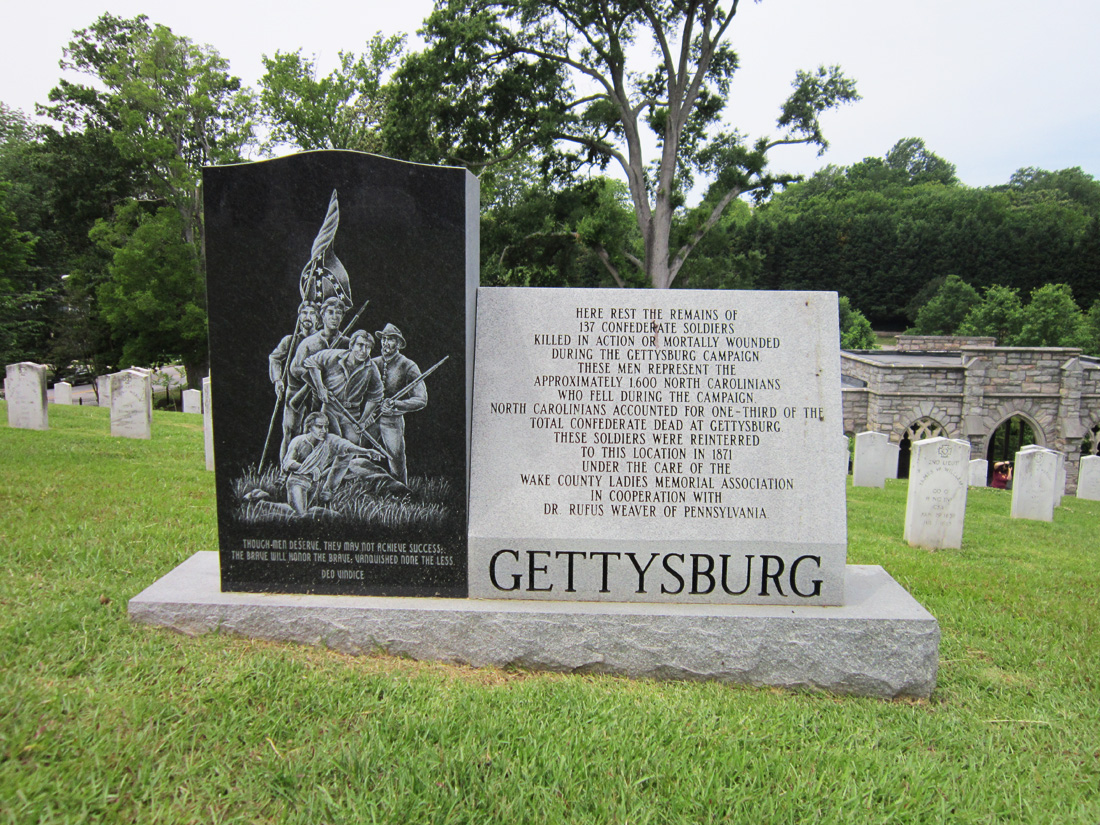
North Carolina Monument
I’m well acquainted with the hundreds of noble stone memorials that dot on the National Battlefield at Gettysburg, the “hallowed ground” of Lincoln’s Gettysburg Address. I understand that kind of memorial. So maybe it’s the impermanence of these urban shrines that bothers me. They seem to be eloquent symbols of the transience that is the bane of our cities. After Whitney Huston’s tragic death, the entire fence in front of her home church in Newark became a veritable wall of balloons and cardboard signs. Each day as I drove by I watched the balloons wither and the cardboard disintegrate until one day the whole sad, soggy eyesore was removed. On to the next memorial shrine!

I also wonder about the context of these symbols. What is the difference between a lily taped to a tree at a murder scene on King Boulevard, and a lily placed on the altar during the Easter Vigil in the abbey church a block away?  It seems to me that the second lily has been given a transcendent meaning by being made part of the church community’s celebration of Christ’s resurrection. The same for a candle. Placed on a sidewalk by an individual it's one thing, but blessed and held aloft in a darkened church as the "light of Christ" it seems to me to take on a deeper meaning. The faith context has given the lily and the candle a deep religious significance they don't otherwise have. Do you agree?
 

On the other hand I’m not at all sure of the context of the various symbols I see on the city sidewalks. A heart-shaped balloon that proclaims “I love you!” is clearly someone’s very personal expression of love and grief. I’m not criticizing that. Just wondering. Are these shrines more "personal" than  "communal" expressions? What purpose do you think they serve in our post-Christian culture? I.e. what is their context?

Here are some more questions that I hope will provoke some feedback in the “Comment” box this week. Please add your thoughts.

First, given that we are symbol-makers by nature, do you think that these impromptu shrines are modern substitutes for the abandoned classical communal religious symbols such as funeral services, hymn-singing, and so forth? 

As a Benedictine I spend hours a day in the world of symbols: bowing, standing, singing, making the sign of the cross, reciting sacred poems (Psalms) with my brother monks. Do you think that this is why I’ve never been tempted to put a candle on a sidewalk – even for a murdered student of mine? 

Do you think that a church-goer is as likely to place a balloon at a "pop-up shrine" as someone who doesn't go to church?

Have you  ever performed some sort of symbolic action like the one I’m talking about? What was the idea or the feeling behind your gesture? 

How about some help on these questions.  I’d be interested in your thoughts.
 
Why do you think people make these shrines?


Saturday, February 23, 2013

SEARCHING FOR MEANING

.
In the past several months several of our students have experienced the death of a parent or a close family member . There are enough of them that our Guidance Department has started a grief counseling group that meets during school hours.

I think of one kid in particular whose dad died within the past month. When I look at him during class I wonder what it must be like to lose you father at age fifteen. I try not to recall too vividly the overwhelming grief I felt in my mid-forties when my brother died, but I figure that for several reason this kid’s grief must be ten times worse. If that’s true, I don’t know how he survives. But yet he shows up for class every day, not always sharp and enthusiastic, but he show up. His face is an eloquent and honest statement of how he is feeling.

LOOKING FOR PERSPECTIVE
The gospel for the Second Sunday of Lent is Luke’s account of the transfiguration of the Lord.

While he was praying his face changed in appearance and his clothing became dazzling white. And behold, two men were conversing with him, Moses and Elijah, who appeared in glory and spoke of his exodus that he was going to accomplish in Jerusalem. Peter and his companions had been overcome by sleep, but becoming fully awake, they saw his glory and the two men standing with him. As they were about to part from him, Peter said to Jesus, “Master, it is good that we are here; let us make three tents, one for you, one for Moses, and one for Elijah.” But he did not know what he was saying. While he was still speaking, a cloud came and cast a shadow over them, and they became frightened when they entered the cloud. Then from the cloud came a voice that said, “This is my chosen Son; listen to him.” After the voice had spoken, Jesus was found alone. They fell silent and did not at that time tell anyone what they had seen.

It seems that this event is meant to be a foreshadowing of Jesus’ suffering and death; it offers his apostles a glimpse of his glory so that they will not completely lose faith when Christ is crucified. This morning I was reading Reginald Fuller’s commentary on this passage and this sentence caught my eye: “But the story (of the transfiguration) has been written up by the later community in the light of its Easter faith.”

The gospels tell us that his followers did not really understand the events in Jesus’ life until after the resurrection. Look at John 2:22, for instance: The Jews said, “This temple has been under construction for forty-six years, and you will raise it up in three days?” But he was speaking about the temple of his body. Therefore, when he was raised from the dead, his disciples remembered that he had said this, and they came to believe the scripture and the word Jesus had spoken.

On Palm Sunday we will hear John 12:16 tell us Jesus found an ass and sat upon it, as is written: “Fear no more, O daughter Zion; see, your king comes, seated upon an ass’s colt.” His disciples did not understand this at first, but when Jesus had been glorified they remembered that these things were written about him and that they had done this for him.

So meanwhile my students live with the pain of grief over their dead parents, living their own share of Christ’s passion without always seeing it from the post-resurrection perspective.
Of course, if we spend our lives running crazily on the surface of life we can’t expect to make any sense of the tragedies and heartbreaks that threaten at times to destroy us. This alone is enough to encourage us to follow through on St. Benedict’s suggestions for Lenten practices: read and meditate on the scriptures more, and spend more time in quiet, introspective prayer.

I think of a favorite old hymn of mine; although the melody is lovely, the words by themselves convey an important message for Lent, and indeed for life: to remember that by identifying with Christ's sufferings on Calvary, we are also partaking in his victory over death at Easter.

1. Jesus, keep me near the cross,
There a precious fountain—
Free to all, a healing stream—
Flows from Calv’ry’s mountain.

Refrain:
In the cross, in the cross,
Be my glory ever;
Till my raptured soul shall find
Rest beyond the river.

2. Near the cross, a trembling soul,
Love and Mercy found me;
There the bright and morning star
Sheds its beams around me.

3. Near the cross! O Lamb of God,
Bring its scenes before me;
Help me walk from day to day,
With its shadows o’er me.

4. Near the cross I’ll watch and wait
Hoping, trusting ever,
Till I reach the golden strand,
Just beyond the river.