Showing posts with label Mystery of Suffering. Show all posts

Saturday, October 10, 2026

The past couple of days I've been reflecting on Jesus' remark to his critics: "But if it is by the finger of God that I cast out demons, then the Kingdom of God is here" (Lk 11:20). I keep picturing Michelangelo's painting of the Creation of man in the Sistine chapel, in which God is reaching out his finger to instill life into Adam. Well, a few minutes ago the Lord put this very picture in front of me; it seems that it is part of a post that somehow never got published but was accidentally left as a draft. So I'm taking the hint and publishing it below.

=========================

I heard a woman writer being interviewed this week on NPR, concerning a book she had written about atheism and atheists. She came across as very reasonable and calm and rational as she explained that many people who wind up rejecting the idea of God do so after the death of a loved one.

She began speaking for these people but soon seemed to be speaking for herself as well,
offering this observation: “Believers will say that despite all the horrible suffering in the world, God has this Grand Plan for the world, but we’re unable to see it.” She went on, “This is such a weak argument, to refer everything to some divine Grand Plan. Anyone could write a better plan than the alleged present one that includes the senseless suffering of babies and the horrible destructive power of hurricanes. Even you or I could write a better plan than that! The idea of a Divine Plan just doesn’t work because it’s so obviously a bad plan.”  

Because of her reasonable and sincere tone of voice, I kept listening to her for a while longer. While there was nothing new in what she was saying, it made me conscious of what a gift my faith is: you can’t reason your way to a Divine Plan that’s behind the present world with its mysterious suffering and evils of all kinds. The writer is correct on that score: from the point of view of reason, this is indeed an inexplicably nasty world much of the time, one that makes no sense, it is indeed absurd. Yet here I am believing confidently that this absurd world is not all there is.

Then this morning I was reflecting on the first reading of today’s mass, the hymn about Christ in Colossians Ch. 1:15-20, which begins “He is the image of the invisible God.” There’s your leap of faith, right? You can’t truly reason your way to an encounter with an invisible God. But the line that really caught my attention is a couple of verses later in Col. 1:17:  “He himself is before all things, and in him all things hold together.” “All things hold together?” Hmm..., I don’t know about that! Looking at the morning headlines one would rather conclude that the Nigerian writer Chinua Achebe was closer to the truth about our world with his book title, “Things Fall Apart.” As I reflected on the image of Christ “holding everything together” I remembered that writer from the radio interview, and I thought, “Well, if Christ isn’t doing such a great job holding the world together, what’s the alternative?” I’m not sure she had answered that question with her idea that your or I could easily write a much better script for running the world. Then a thought jumped out at me. Yikes! Writing my own story? That’s exactly where I get
myself in trouble, isn’t it? I reject the Gospel script centered on Christ's self-sacrificing love, and start writing my own, presumably “better” version of my story. My version avoids, say, the inconvenience of helping a needy neighbor, or the accepting of consequences of my own actions. So my improved story starts to include self-centeredness and lying. Now, so far, I have to admit that this does not really sound like much of an improvement over God’s Grand Plan with its infant deaths and killer hurricanes. I humbly admit that, as much as I may dislike the present mysterious Plan, I really cannot offer a better one. How about you? So, in the absence of a better story, I embrace the one we’ve been given, and call it “my story,” and turn it into “my song.” Frances J. Crosby did just that with her beautiful hymn,
Blessed assurance, Jesus is mine!
Oh, what a foretaste of glory divine!
Heir of salvation, purchase of God,
Born of His Spirit, washed in His blood.


Refrain:
This is my story, this is my song,
Praising my Savior all the day long;
This is my story, this is my song,
Praising my Savior all the day long.


Perfect submission, perfect delight,
Visions of rapture now burst on my sight;
Angels, descending, bring from above
Echoes of mercy, whispers of love.


Perfect submission, all is at rest,
I in my Savior am happy and blest,
Watching and waiting, looking above,
Filled with His goodness, lost in His love.

I keep praying for that good woman I heard on the radio, imagining her delighted surprise when she dies and wakes up to behold the Great Plan in its fulness in heaven!

Sunday, September 20, 2026

I DON'T UNDERSTAND


Very often when someone comes to me to tell me about their suffering, about some awful thing that is happening in their life, they will say, “I don’t understand! Why would God allow this terrible thing?”

Aristotle begins one of his works with this simple statement: “All humans desire to


know.” And to me, this is exactly what gets us into trouble in our relationship with God. We want to know why God did or allowed a certain event in our lives. This is, of course, particularly troublesome when the event is a negative one. Why does God allow evil to exist in the world?

Usually that question is posed as an indirect challenge to God.  As Aristotle says, we all want to know. But, as we all have experienced, the so-called “problem of evil“ is completely unsolvable from our limited  human perspective. 


The Gospel reading for today (Sunday, September 20) presents the familiar parable about the workers in the vineyard, and that they were all paid the same wage at the end of the day, whether they had worked eight hours or only one. 

The first reading at mass prepares us to hear the parable. It’s the Lord speaking through Isaiah.  I’ve reprinted it herewith some words in bold type.:


Seek the LORD while he may be found, call him while he is near. Let the scoundrel forsake his way, and the wicked his thoughts; let him turn to the LORD for mercy; to our God, who is generous in forgiving. For my thoughts are not your thoughts, nor are your ways my ways, says the LORD. As high as the heavens are above the earth, so high are my ways above your ways and my thoughts above your thoughts (Isaiah 55:6-9)

Now let’s return to my friend who is struggling to come to grips with some terribleevent in her life, and who complains  “I don’t understand! Why would God allow this terrible thing?” Will this passage from Isaiah be of any comfort to her? I doubt it. Her complaint, “I just don ‘t understand” is still sitting there.

We Christians, however, have a few ways of approaching the problem of evil. None of them provide “answers” or “solutions”, but rather they offer us a place to stand, a bit of perspective. At the center of the issue is the idea of “mystery.” The Lord is clear: “For my thoughts are not your thoughts, nor are your ways my ways,”

I’m not God, and so shouldn't expect to grasp the mystery of God’s hidden plan. The virtue of Hope, however, is God’s gift that strengthens me to believe that God has a loving plan for the world, and that whatever things may look like to me, God's plan is working itself out in ways that I simply can’t comprehend with my limited intellect.

This won’t help my friend to “understand” anything, but it offers a place to stand, a perspective. In the end, then, I need to trust in the Lord’s goodness and wisdom and infinite Love. 

I wonder what that vineyard worker felt like as he walked away with his denarius after a full day’s work knowing that some of his fellow workers got their denarius for working only one hour. Maybe he mumbled “I just don’t understand!"


"My friend, I have done you  no wrong..."


Sunday, September 13, 2026

WHERE WAS GOD ON SEPT. 11, 2001?

This past Friday, September 11, we made a good effort (somewhat successful, I think) to acquaint our 800 students with what "Nine-eleven" is all about. A colleague said to me in  a conversation that the way you can tell that this day is important is that twenty-five years later Americans over the age of thirty-five can tell you where they were on the morning of Sept. 11, 2001. 

In this post, though, I'd like to ask not "Where were you?" but rather "Where was GOD on September 11, 2001?" Countless numbers of believers have asked themselves that question, sometimes in anger, sometimes in bewilderment. I'd like to offer the following essay by a monk, Aelred Graham, excerpted from his book, Zen Catholicism. Parts of it are a bit dense, but it may be of some help to you.

Among the factors that turn the existence of suffering into a "problem," even for religious people (perhaps especially for them), is a tendency to apply to God their own notions of good and evil, right and wrong. The expectation that the Almighty will conform to a moral pattern laid down for him in advance by his creatures still endures, despite the whole weight of biblical evidence to the contrary. The assumption that if one's conscience is clear God must be on one's side explains the self-righteousness that usually characterizes this or that "crusade" -- "we" being in the right, “they” hopelessly in the wrong — in which the participants are confident that they are fighting the battles of the Lord. 

A Christian truth which, often to our great detriment, we are for some reason reluctant to face is that God is implicated in created evil. Does disaster strike a city if the Lord has not sent it? I make the light and create darkness. I make weal and create woe. I, the Lord, do all these things. These texts from the inspired scriptures are to be explained in the light of a consistent theology, but they are not to be explained away. God has created a universe in which his positive action, the generation of things, implies a corresponding negative corruption or destruction. In order that human beings may live, part of the animal and vegetative world must die. Even moral evil, ť sin, falls within the divine plan. Though sin, being a defect in a creature's will, does not require God's causality, sin could not happen unless God permitted it. God, having created a race of frail human beings, takes account of the fact that large numbers of them will prove their frailty in action. God's universe contains the built-in realities of physical and moral evil. 

A commonly felt reluctance to face the fact that evil enters into God's scheme of things is due to a mental confusion. God is supremely good, we rightly say: therefore he can have no part in evil. But the conclusion does not follow. There is a distinction to be drawn between the ontological goodness, which is one of God's attributes, and moral goodness, which is based on conformity to an external norm. God is infinitely good because he lacks nothing of being, but his actions are not regulated by any norm other than his own inscrutable wisdom. God's holiness, which means "wholeness," includes all that is positive in moral goodness as we understand it; but what he sees as beneficial to the universe as a whole may involve evil to individuals. If we are to discover our true self, which is our being as harmonized with God, then we must learn to look upon areas of evil, not with approval, but calmly and dispassionately. What God tolerates we have no business to find intolerable. Or, to state the same point in more positive terms, we should seek to become increasingly identified with the attitude of your Father in heaven, who makes his sun rise on the evil and equally on the good, his rain to fall on the just and equally on the unjust. 

.

Saturday, March 14, 2026

GOD'S APOLOGY

You may notice that the question of suffering and the problem of evil have been favorite topics in this blog on and off for years. In the left hand column on this screen you can scroll down to "labels" that link you to posts about "God and Suffering," and "The mystery of Suffering." During the past few days it seems that I've been asked to share in the pain and suffering of a couple of friends and relatives. To be honest, it's been a heavy lift at times. Rereading the following passage was he help to me. So I'm sharing it with you.

A SURPRISING SIDE OF GOD

There is at this moment, in the back of some forsaken church, or even ordinary house, or at the turning of a deserted path, a poor man who joins his hands and from the depth of his misery, without very well knowing what he is saying, or without saying anything, thanks the good Lord for having made him free, for having made him capable of loving. 
There is somewhere else, I do not know where, a mother who hides her face for the last time in the hollow of a little breast which will beat no more, a mother next to her dead child who offers to God the groan of an exhausted resignation, as if the Voice which has thrown the suns into space as a hand throws grain, the Voice which makes the worlds tremble, had just murmured gently into her ear, “Pardon me. One day you will know, you will understand, you will thank me. But right now, what I am looking for from you is your pardon. Pardon.” 
These -- this harassed woman, this poor man -- are at the heart of the mystery, at the heart of universal creation and in the very secret of God. What can I say of it? Language is at the service of intelligence. And what these people have understood, they have understood by a faculty superior to intelligence although not in the least in contradiction with it -- or rather, by a profound and irresistible movement of the soul which engaged all the faculties at once, which engaged to the depth their entire nature… 
Yes, at the moment that this man, this woman, accepted their destiny, accepted themselves, humbly -- the mystery of creation was being accomplished in them.  While they were thus, without knowing it, running the entire risk of their human conduct, they were realizing themselves fully in the charity of Christ, becoming themselves, according to the words of St. Paul, other Christs. In short, they were saints.                                            - Charles Peguy (1873-1914)

This God who identifies with our suffering and apologizes because we cannot understand how it fits into the Divine Plan of Love for the world -- this sounds much more like the God that Jesus came to reveal to us. This is the God of Love, but also the God of Surprises and, unfortunately for us, the God of Mystery. I say let's accept the apology gracefully and keep on letting God love us in the midst of all the world's problems. And, of course, try to pass on that love to the people we are living with.
Maybe sometime I'll explore the idea of how our loving God uses adversity to strengthen us and help us grow in love for one another.
 Meanwhile, as we get closer to Holy Week, let us ask the Lord to help us to imitate his example on the cross by growing in self-giving love.

Sunday, October 5, 2025

THE MUSTARD BUSH

Today's gospel passage has got me thinking about Mark's parable of the mustard seed.

Jesus said, ‘With what can we compare the kingdom of God, or what parable will we use for it? It is like a mustard seed, which, when sown upon the ground, is the smallest of all the seeds on earth; yet when it is sown it grows up and becomes the greatest of all shrubs, and puts forth large branches, so that the birds of the air can make nests in its shade.’ Mark 4:30-32

The Old Testament contains some metaphors based on the towering cedar tree magnificently reigning over the rest of the forest. Jesus makes a point of avoiding that metaphor in favor of the mustard plant, which grows to a height of three to about ten feet. Using one of his favorite devices, Jesus catches his hearers off guard with this surprising comparison. Its pointed irony would not have been lost on them: the Kingdom is not about being the biggest and the mightiest. But there are other things that people knew about mustard plants that would have given the metaphor even more punch.
....
THE KINGDOM AS A WEED

There are two more things we can take from this image: Pliny in his Natural History says that the mustard plant is “hearty and intrusive.”

First, the Kingdom is as hearty as a mustard plant: it’s hard to kill. Some years ago I wrote a post celebrating the hardiness of the faith in Haiti. The Kingdom there is proving amazingly hearty, showing itself in people’s sending their prayers of lament, praise and thanks heavenward from the midst of the rubble and the misery. Is the Kingdom that hearty in my life, I wonder, surviving every challenge and difficulty?

Second, the kingdom, like the mustard plant, intrudes where it’s not necessarily wanted. This first definition of a weed I came across seems to fit well enough. “Weed: a plant considered undesirable, unattractive, or troublesome, especially one growing where it is not wanted, as in a garden.” Think of some of the hearty weeds that keep trying to take over your own garden. The Kingdom, it seems, is supposed to be troublesome like that, popping up in our life in areas where we’d rather not have it. It may show up just as I’m about to say something that would move my plans along but which would be rude or hurtful to someone. Or maybe it will intrude as I’m wondering if I really have any responsibility to help the poor people in Haiti. Some call it the voice of conscience, which is fine, too; we know that it's a sign of the presence of the Kingdom.

The Kingdom is like a mustard plant -- hearty and intrusive. When I pray “Thy Kingdom come” I’d better be ready for something “undesirable, unattractive, or troublesome” to get in the way of my plans and which may prove very hard to get rid of once it takes root in my heart!


Sunday, August 31, 2025

SANDALS AND MOSAICS

A close friend asked me to write a note to her sister, a firm believer who is fighting a losing battle with cancer, and has been wondering how we can be sure that God really is present in the midst of our sufferings. Since I've been praying hard for her for months, I felt that the Lord might offer me a few words of comfort to her. Here is what I wrote to my friend's sister a couple of days ago:.

=============================================

Dear_________________,

Here are a couple of thoughts that might be helpful to you right now.

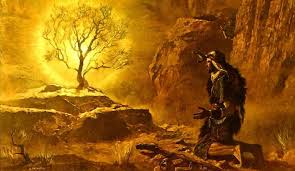
If you look at the Book of Exodus chapter 3, the story of Moses and the burning bush, you will see in verse 5 that Moses is told. “Take off your sandals, for you are on holy ground!“ This is because he is in the presence of the Mystery of the Divine, namely, God. So he has to take his sandals off out of reverence for the mysterious presence that he will never be able to comprehend or understand. God is just too big for our intellects.

So when you or I are standing in the presence of some terrible suffering or some awful evil or some tragedy, the first thing we must do is take off our shoes! We are in the presence of a deep mystery that we cannot comprehend. That means that we cannot really “know” for sure if God is really here in the midst of all this suffering. All we have is the gift of faith.

Today is the feast day of Saint Augustine. He once wrote that our

life is like a beautiful mosaic. But the problem is that we only get to look at the mosaic from very close up. We see only one or two little pieces of the mosaic, and therefore it makes no sense to us. But when the Lord calls us home to heaven, we get to look at the entire mosaic. Then we can finally see that the whole picture is so unbelievably beautiful and full of love that it takes our breath away.

But the way things are in this life, we don’t get to see the whole thing.

Yet if you listen hard, you can hear the Lord apologizing to you. “I’m sorry. I wish you could see the whole picture right now, but in order for you to do that, you would have to be God. So, I’m sorry. I apologize. But for right now, please try to trust me. Look for all those bits of love that I reveal to you every day. That’s the best I can do.”

There. That’s at least my way of looking at things.

I hope this was of some help.

Love and prayers,

Fr. Albert

No Shoes, Please
!


Sunday, March 9, 2025

WILDERNESS AGAIN


I gave a day of Lenten Reflection yesterday using the following idea. I've used it before, but the response it received yesterdays way made me decide that it is worth revisiting.

Wilderness as a Metaphor 

We all know the story of how, after the tenth plague in Egypt, Pharaoh at last consented to let
the Israelites go into the wilderness to "offer a pilgrim-feast to the Lord." At that point Moses led them on a daring dash for freedom, through the Red Sea and out into the wilderness in what appeared to be a charge into the open jaws of death. In this wilderness there was little water and no food, only hostile tribes and poisonous snakes. 


Midbar
"Wilderness" translates the Hebrew word, midbar, which is sometimes incorrectly translated as "desert."My Hebrew dictionary says that midbar means "tracts of land used for pasturing flocks and herds; uninhabited land." The word conveys the sense of a land that is still wide open space, un-surveyed, unmapped, undomesticated by humans. The wilderness is land that is still relatively free of human control. In Exodus theology the wilderness represented divine presence, lack of human control -- and freedom. 

In sharp contrast to the wilderness stood Egypt, which was very much under human control. In fact, the Egypt of the Pharaohs was famous for its order and neatness. So Egypt represented human rationality, human order -- and slavery. Thus in Israel's tradition the wilderness came to symbolize the unpredictable and unfathomable side of life, the mystery of God. This contrast between Egypt and the wilderness is crucial to a Christian view of troubled times. 

The Wilderness as "God's Country" 

We can use the word "wilderness" to refer to any and all of those difficult times we ourselves
experience, as well as the times when we are experiencing the pain of others second-hand as I have been this past week. To live in the wilderness means living in mystery, where things are beyond my understanding and my control; it is to live in "God's Country." 

There is another important dimension to the wilderness symbolism. In Hebrew thought, history is experienced as linear, not cyclical: it starts with creation and moves relentlessly toward its fulfillment. 

We individuals are born into that flow and are called to shape it by our decisions. We are moving onward with the flow of time toward the future. God gives us the future and we accept it from his hand. When Israel was called out of Egypt, she was also called out of the past and asked to move joyfully and trustingly into God's future. The wilderness, then, was not only a symbol of divine mystery but also a symbol of the future. Each of us is called, like the Israelites, into an unknown future; but if we don't know God's goodness or trust in God's love, we experience the future as a threat. On the other hand, if we trust in God's goodness and love, then the future is transformed from a threat into a promise. The wilderness as the unknown future is in a special sense God's preserve, it is par excellence "God's Country." 

So, if I had to say a word of comfort to any of the people I’ve been praying for, I’d probably say something like this: 

"I see that right now events in your life are completely beyond your control, and the future is unknown and terrifying; you are in the land of darkest mystery. Well, take off your shoes, because you are on holy ground. Welcome to the wilderness -- welcome to God's country! This is where the Lord is expecting to meet you and love you and deliver you." 

Let’s all pray for our brothers and sisters who find themselves victims of every mysterious kind of tragedy around the world, and any people who are right now wandering in a land of fearful mystery. May they experience the reassurance that comes from realizing that the trackless wasteland in which they find themselves is indeed God’s mysterious country, and that God fully intends to meet them there – and probably already has. 


Sunday, October 20, 2024

THOUGHTS ON SUFFERING

During the past week or so I have been meditating on a couple of passages from Richard Rohr's “The Divine Dance.” I would like to share a few of these thoughts with you in the hope that you may want to read the complete version in the book itself:

Awe and wonder are terms that are often correlative with mystery. All fundamentalist religion is terribly uncomfortable with mystery; it likes to take full control of the data, and mystery by definition leaves you out of control. Such moments of vulnerability are the very space where God can most easily break in with fresh experience; in fact, I doubt if God can break through in any other way.   …

Suffering is the only thing strong enough to break down your control systems, explanatory mechanisms, logical paradigms, desire to be in charge, and carefully maintained sense of control. Both God and the guided soul know to trust suffering, it seems. 


God normally has to lead you to the limits of your private resources. Some event, person, or moral situation must force you to admit, I cannot do this in my present state. This is our suffering.

Or your understanding of “what it all means“ has to fail you in a very personal way: I can’t make sense of this. I can’t get through today.

This often happens when there has been a physical death, or the death of a marriage, a reputation, or an occupation. But you always feel both afraid and trapped. “How?” You cry out with ten levels of anguish and impossibility.

A good spiritual Director might say quietly to themselves (not to the sufferer), Hallelujah! Now we’re going to begin the real spiritual journey. P.125

I hope that something in this post will catch your attention and challenge you the way I have been challenged myself.

Can you let go and let God catch you?


Saturday, March 16, 2024

Not Yet!

My hour has not yet come
In the last sentence of this past Friday’s gospel passage, St. John tells us that the crowd in Jerusalem could not attack Jesus “because His hour had not yet come.”

He uses that phrase a couple of times in his gospel. First, we remember the scene at Cana when his mother asks him to solve the problem of the wine running out, and he explains “my hour has not yet come.”

Then, in verses skipped in the editing of Friday’s passage, from John Chapter 7, when “his brothers” encourage him to go up to Jerusalem, he replies “my time is not yet here;” and in the following verse he explains to them “I am not going up to this feast, because my time has not yet been fulfilled.” 

And then the verse in Friday’s gospel, “no one laid a hand upon him, because his hour had not yet come.”

In each of these passages, the same word shows up in the original Greek: oupo, a very common adverb meaning: “not yet.” 

As ordinary as the word  oupo, “not yet” may be, it is crucially important in all the passages we just heard: To say that the hour has NOT YET arrived indicates that eventually the hour WILL arrive.

It implies that Jesus' life is following the plan, but as of yet not all the stages of that plan have occurred. But they will. Christ’s earthly life is following a trajectory, heading in a single direction: it has significance, it has meaning.

And if that’s the case, then we who have Christ living in us and who are living in Christ, we are also living out that plan, following that same trajectory. This is especially important for you and me to remember when things are going badly. In times of pain and hopelessness we can hold onto that little word  oupo , “not yet,” that assures us that no matter what things may look like, our lives are heading in a certain meaningful direction, and therefore, everything in our lives has meaning, even and especially the seemingly bad parts.

Father, the hour has come
At the last supper, Jesus says, “Father, the hour has come, glorify, your son.” It is in his suffering and death that he finally reaches the hour, his goal: the Glory of the father. And we who have suffered with him will one day be glorified with him as well.

Each year during Holy Week and Easter, we celebrate the “hour,”  we remind ourselves how the story turns out:  Christ’s passion and death are oupo, not yet the end of the story. We know that the Easter mystery does not end on Good Friday: we live in the assurance that Sunday is coming.

The idea of oupo, “not yet” disappears early on Easter morning, when Christ is finally raised to a new life, and then in the ascension is brought to the fullness of glory at his Father's right hand. 

And we who are still suffering here in this vale of tears are on our way to join him there. It's just that our own hour of glory has not yet come. 

A final thought: Lots of times when when it seems that "God didn't answer your prayer," the Lord did in fact give an answer to your request -- the answer was oupo. 

Oupo -- Not yet!


Saturday, March 9, 2024

CHRIST LIFTED ON HIGH

 In this morning’s gospel we heard Jesus tell his disciples, 

“And just as Moses lifted up [hupsoō] the serpent in the desert, so must the Son of Man be lifted up [hupsoō] so that everyone who believes in him may have eternal life”

I’[d like to offer some thoughts about the Greek verb hupsoō,  “to lift up.” 


Most of the time in the New Testament the word is used figuratively for “lifting” someone to a position of honor or power: “Whoever exalts [hupsoō] himself will be humbled, and whoever humbles himself will be exalted [hupsoō]” (Matt. 23:12).

But John uses it in its literal sense in this morning’s gospel when referring to a scene from the book ofNumbers In which Moses fashions a bronze serpent so that the Israelites who are being punished by being bitten by "fiery serpents" can gaze on the bronze figure and be healed.

This is what Jesus is referring to when he says, “Moses lifted up [hupsoō] the serpent in the desert” (John. 3:14a).

This literal use of “to lift up” in the Old Testament provides John with exactly the image he needs to express Christ’s being physically “lifted up” on the cross: he writes “And just as Moses lifted up [hupsoō] the serpent in the desert, so must the Son of Man be lifted up [hupsoō] so that everyone who believes in him may have eternal life.”

With his love for double meanings, John will continue this image of “lifting up” later on, in Jesus’ambiguous promise, “And when I am lifted up [hupsoō] from the earth, I will draw everyone to myself” (John 12:32-34). 

Does this “being lifted up” refer to Christ’s being literally lifted up on the cross, or to his finally being lifted up in glory to the right hand of God? Or does it refer to both at the same time? 

John’s deliberate ambiguity points up the mysterious nature of the crucifixion and of all human suffering. 

But he also gives us a central insight about human suffering later in his gospel when he writes that by being lifted up on the cross Christ “draws all to himself” (Jn 12:32-33): 

Calvary is just the first step in a process. 

After being “lifted up” onto the cross Jesus will then be “lifted up” out of death by his Father and finally raised on high to sit at the right hand of the Father. 

And – here is the crucial point -- we too are to be lifted up along with him as he draws us all to himself!


John, by playing on the double meaning of “lifted up,”  links our human suffering with the mystery of Calvary, and then, 
with the cross as the starting point, describes a single upward surge in which all of creation – including our darkest valleys of sin and suffering – is embraced by Christ and lifted heavenward by him and with him in the vast, infinite and inexorable power of divine unconditional love. 

And so, Christ’s cross becomes the very means by which all of us, too, are lifted to salvation. 

Suffering is a mysterious but somehow an integral part of this ceaseless upward movement of divine love.

So, let us pray that we may be blessed with the eyes of faith when we look on our troubled world – just as when we look upon a crucifix. 

With those eyes and with the help of John’s beautiful image, we may be able to see that we and our dark valleys, and the whole world and its struggles, are continuously being “lifted up” by Christ in that single inevitable heavenward motion when all creation has been transformed, and every tear wiped away, and when every evil has been overcome and every pain forgotten amid the eternal joys of heaven.


Saturday, December 30, 2023

WAIT, EXPECT, WELCOME


The Church includes in the liturgical readings of Christmas season the story of the infant Jesus being presented in the temple (Lk 2:22-35). You remember that reads in part:

When the days were completed for their purification according to the law of Moses, the parents of Jesus
took him up to Jerusalem to present him to the Lord, ...  Now there was a man in Jerusalem whose name was Simeon. This man was righteous and devout, awaiting the consolation of Israel, and the Holy Spirit was upon him. It had been revealed to him by the Holy Spirit that he should not see death before he had seen the Christ of the Lord.

In this post I want to look closely at the verb that Luke uses to describe Simeon: awaiting the consolation of Israel. The word prosdechomai  has a variety of meanings, each of which can help us reflect on our own way of celebrating this holy season.

THREE MEANINGS

WAITING. The verb can mean ¨to await with confidence or patience.¨ During the holidays we can find ourselves waiting for our guests to come, as we know they will.

EXPECTING. Another related meaning of our verb is ¨to wait upon, to expect.¨ As the time draws near for the arrival of the family´s guests, the kids get more and more excited, and they sit staring anxiously out the front window, hoping to be the first to recognize their uncle´s car as it comes down the street. 

WELCOMING. a third common meaning of prosdechomai closely related to the above two is ¨to welcome. to offer hospitality. ¨

SIMEON IN THE TEMPLE

Now let´s watch Simeon as Joseph and Mary walk in carrying their baby. Simeon, we´re told, has been assured by the Lord that he would see the Messiah before he died; so, naturally, he is ¨waiting with confidence and patience." 

But even more, we can imagine him ¨waiting upon¨ and ¨expecting¨ the Messiah at any moment. He is constantly on the lookout for the fulfillment of the divine promise.

So imagine his surprise when the Spirit leads him one day into the temple and points out a babe in the arms of its young mother and announces: ¨Here he is at last, the One who is to deliver Israel! ¨ The old man responds immediately to the unlikely inspiration by ¨welcoming¨ the infant, cradling him his arms and praying, 

"Lord, now let your servant go in peace;
your word has been fulfilled:
my own eyes have seen the salvation
which you prepared in the sight of every people,
a light to reveal you to the nations
and the glory of your people Israel" (Lk. 22:29-32). 

WHAT ABOUT YOU AND ME?

Simeon is a good model for us to imitate. We might ask ourselves, ¨Am I waiting for the Lord to come into my life? ¨ ¨Are we indeed watching for him to approach us in some unexpected way? Or willwe miss Him when he comes in some unexpected way?¨ ¨Do we truly welcome Him into our lives, do we make room in our hearts for Him, or are our hearts too crammed with worldly concerns and worries? ¨ 

Let us pray that the Lord Jesus will find us as ready as Simeon was to recognize Him when He comes into our lives. May we welcome him with Simeon´s open arms.


Tuesday, November 14, 2023

SANDPAPER SPIRITUALITY

 I recently attended a three-day conference for Benedictine priors at St. Leo Abbey in Florida. The featured speaker was Dom Cuthbert Brogan, the abbot of Farnborough Abbey in England. His four talks were very down-to-earth and helpful.

Peace Among Thorns

Peace among thorns
In his very first talk he offered an insight that I found really helpful. The main idea was this: We tend, these days, to forget that at the center of the monastic life is the mystery of the cross. This sense of the cross is often missing among young people coming to the monastery today: "When things get tough, you leave."

The mystery of the cross needs to be at the center of our idea of community life. Without it our community will have no room for imperfect members or for people struggling with difficulties in their personal lives. The ideal of a ¨perfect community" will  discourage us from facing and dealing with the ugly realities of monastic life. The Benedictine motto of ¨peace" must always refer to ¨peace among thorns.¨ Difficulties in our monastic life should not surprise us.

Turning the Tables

At this point Abbot Cuthbert began using the image of sandpaper, and the fact that if a surface is in need of smoothing and polishing we set to work with the abrasive surface of sandpaper. I got ahead of his thinking, however, figuring that he was going to say that the brethren should approach a problem monk and try to fix him, smooth him out so to speak. But the Abbot turned my thinking on its head: Rather than seeing difficult monks as problems to be fixed (sanded down), I should see them as the sandpaper that improves me by requiring me to exercise patience, empathy, gentleness and so on. I am the one who is improved by facing the cross in my own life.

This is great advice for a prior in a monastery, who can easily get caught up in correcting imperfections in his brothers, in fixing wayward monks. 

From now on I will try to keep an eye out for the sandpaper that the Holy Spirit sends into my life whether in the form of a struggling brother or a painful situation.