Showing posts with label Kingdom of God. Show all posts

Sunday, October 26, 2025

GET READY, GET SET...

From time to time I will run into one of our high school Students standing in the hallway. I say to him “what class are you supposed to be in right now?“ And he Will answer “I’m getting ready to go to English class.“ The response “I’m getting ready come across as awfully evasive. It leaves open the questions “what are you doing in the hallway?” And quote, why aren’t you in class?" The great French religious philosopher Blaise Pascal writes somewhere that many Christians waste their Present lives Waiting for heaven, which is their goal.

In some of the recent Mass readings, we have heard Jesus telling us to prepare for the master's return. But he doesn’t tell us to simply “await” that return.

The center of his message is that the kingdom of God is already among us. This kingdom exists, if you will, in this spaces between us.

I need to ask myself what characterizes the space between me and, say, this particular brother. Is it envy? Sympathy? Jealousy? Or self-giving love? That’s where the kingdom exists already!


Yesterday I had this awful thought: I imagined that I had died, and Jesus was asking me how I had spent my life. And I answered “I was getting ready!”

That is not the response we Christians are supposed to give in accounting for our lives.

Blaise Pascal 1623 - 1662

We are each called to make a liar out of Blaise Pascal by spending our lives on earth being Christ for everyone we meet. We are supposed to be helping to build the kingdom on earth. 

We have no time to waste by just “waiting for the Lord to return.”


Sunday, October 5, 2025

THE MUSTARD BUSH

Today's gospel passage has got me thinking about Mark's parable of the mustard seed.

Jesus said, ‘With what can we compare the kingdom of God, or what parable will we use for it? It is like a mustard seed, which, when sown upon the ground, is the smallest of all the seeds on earth; yet when it is sown it grows up and becomes the greatest of all shrubs, and puts forth large branches, so that the birds of the air can make nests in its shade.’ Mark 4:30-32

The Old Testament contains some metaphors based on the towering cedar tree magnificently reigning over the rest of the forest. Jesus makes a point of avoiding that metaphor in favor of the mustard plant, which grows to a height of three to about ten feet. Using one of his favorite devices, Jesus catches his hearers off guard with this surprising comparison. Its pointed irony would not have been lost on them: the Kingdom is not about being the biggest and the mightiest. But there are other things that people knew about mustard plants that would have given the metaphor even more punch.
....
THE KINGDOM AS A WEED

There are two more things we can take from this image: Pliny in his Natural History says that the mustard plant is “hearty and intrusive.”

First, the Kingdom is as hearty as a mustard plant: it’s hard to kill. Some years ago I wrote a post celebrating the hardiness of the faith in Haiti. The Kingdom there is proving amazingly hearty, showing itself in people’s sending their prayers of lament, praise and thanks heavenward from the midst of the rubble and the misery. Is the Kingdom that hearty in my life, I wonder, surviving every challenge and difficulty?

Second, the kingdom, like the mustard plant, intrudes where it’s not necessarily wanted. This first definition of a weed I came across seems to fit well enough. “Weed: a plant considered undesirable, unattractive, or troublesome, especially one growing where it is not wanted, as in a garden.” Think of some of the hearty weeds that keep trying to take over your own garden. The Kingdom, it seems, is supposed to be troublesome like that, popping up in our life in areas where we’d rather not have it. It may show up just as I’m about to say something that would move my plans along but which would be rude or hurtful to someone. Or maybe it will intrude as I’m wondering if I really have any responsibility to help the poor people in Haiti. Some call it the voice of conscience, which is fine, too; we know that it's a sign of the presence of the Kingdom.

The Kingdom is like a mustard plant -- hearty and intrusive. When I pray “Thy Kingdom come” I’d better be ready for something undesirable, unattractive, or troublesome” to get in the way of my plans and which may prove very hard to get rid of once it takes root in my heart!


Sunday, September 28, 2025

KINGDOM SPACES

There was once a rich man ...

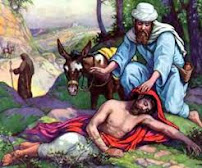
Today's gospel parable about the rich man and Lazarus (Lk 16:19-31) got me thinking about the Kingdom of God. I like to imagine the Kingdom of God as “existing in the spaces between us.” We are each responsible for what characterizes those spaces: mutual care? anger? jealousy? empathy?


In the case of the rich man, he was not even aware of the existence of the beggar at his front door. What characterized the space between him and Lazarus, at least from the rich man's perspective? Maybe indifference. In any case, it was not the “Kingdom” Jesus had come to establish on earth.


Interestingly, the parable ends with the image of a space between the two characters: an unbridgeable space separating the two of them. And it is too late for the rich man to bridge that space by filling it with compassion. He is, however, the one responsible for the chasm.


So there are at least a couple of lessons for us in this parable. First, we need always to be aware of the people that God has placed in our lives, especially those whom we may be tempted to pass by without noticing them. (It’s no coincidence that this poor man, Lazarus is the only character in any parable who is given a name), And second, we are responsible for how we treat those people. So we could say that the Kingdom means filling the species between us with love, right?

Yes, I suppose that's true. But we should not forget that the Kingdom is not always filled with "nice" experiences. The experience of the Kingdom also includes sharing in the sufferings of Christ, the King.

So when we are experiencing pain and suffering, we have to try to experience them as a share in the mystery of Christ's pain and suffering. These ended, as promised, in victory over death and suffering. Ultimately, the kingdom is about Easter.

My faith in Christ the Risen King assures me that if today is Good Friday for me, then Easter is coming!

I once heard this saying, attributed to a wise old rabbi: "God is not nice. God is not your uncle. God is an earthquake." 

I don't know about you, but I have certainly met this Earthquake God a few times. But this God is also the God of the Paschal mystery who raised Jesus from the dead. The God of love whose ways are unfathomable to us.

Our faith assures us that in the end, God always wins, and the Kingdom always comes. When we pray "Thy Kingdom come," we are committing ourselves to help to bring it about by filling all the spaces in our lives with Christlike love.  


Saturday, June 14, 2025

THE TRINITY AND THE KINGDOM


Over the years I've reflected many times on the two topics of the Holy Trinity and the Kingdom of God.  (You can use the "Labels" list in the column to the left of the screen to click on each of these topics for a more thorough treatment of each.) 

On this Trinity Sunday, June 15, I'd like to reflect on how similar these two mysteries are. I hope my brief summaries of the Trinity and the Kingdom will be of some help.

 GOD AS TRINITY

The Holy Trinity is the complete expression of God’s Love. When a family is faithful, their love transforms itself into the image of the Holy Trinity on earth. The Holy Trinity, like the family, is above all a mystery of unity. Love is union. Two spouses who love one another are united, and two distinct persons who become one: “And the two shall become one flesh.” This unity and diversity of two-in-one helps us to understand the Trinity: Three in One, three distinct persons in a unity of love.


The Holy Trinity, like the family, is a mystery of fruitful love and unity. The man and woman who love each other participate in the creative power of God, in the Love that gives life. The child is the living image of the parents’ love, just as in the Trinity, where the Son is the perfect Image of God.

If God is a Trinity of distinct persons, then God is relation-ship. To make it sound more real you can say that God is family. If that’s so, then you need to approach the mystery of the Holy Trinity with more than just your mind -- you need an open heart. To grasp more about the Trinity you have to be ready to receive God into your life, this God who is boundless, unconditional love.

God is family. We are all family. Think of that the next time you’re thinking ill of someone, especially someone who hates you. No matter who that person is, you have to say to yourself, “I better be real careful because after all that person is family.”

If your God's love has boundaries around it and is limited to only certain people, then that is not the Triune God of the Christian faith, but a God with boundaries. A god with boundaries is obviously not much of a God, but rather an idol.

Our belief in the Trinity, in God as Family, challenges us to open our hearts in LOVE to all of creation. Sure we may fall short of this, but the Trinity is like that -- something we never quite get completely.


On our end, we can deflect or interrupt the Flow of love in our lives, we can isolate ourselves from the divine circle dance, but the Spirit is always working to draw us back into it.
 
THE KINGDOM

In the gospels Jesus tells his disciples,
“The kingdom of God is among you.” The kingdom that Jesus began is a whole new way of relating with God and with one another, that is, a whole new way of filling the space between us.

The kingdom exists not so much inside each of us as in the spaces between each of us. We get to decide the character of each of those spaces. I freely choose how to fill that space between me and a student, say, or between me and a street beggar, of between me and a brother monk, and so on.

The Kingdom, then is all about relationships of LOVE.
And the Trinity, too, it turns out, is all about relationships of LOVE.

The two deepest mysteries of our faith, then, are about the same thing: LOVE:

THE HOLY TRINITY: God's mysterious internal life of the mutual love of three persons and infinite love for us creatures.

THE KINGDOM OF GOD: The Love that comes about in the spaces, the relationships between God and us and our neighbors.

La Santisima Trinidad - C. Cervantez


Saturday, March 1, 2025

LEARNING FROM CHILDREN

 “Amen, I say to you, whoever does not accept the Kingdom of God likea child will not enter it." (Mk 10:16)

After preaching on this passage from today’s gospel at our community mass this morning, I came to my room and continued reading a book entitled “A time to die.” Written in French, it recounts stories of how monks in eight monasteries in France had faced death. It is, as you would expect, a little somber at times, but the overall thrust is that monks generally see death as simply a transition to the eternal life that they’ve been aiming at during their entire life in the monastery.

This quotation on one Abbot’s coat of arms summarizes his spirituality: “As newborn babes." Because its message is so close to today’s gospel passage, I would like to share an entire long paragraph with you (my translation). The abbot wanted to explain his choice of this bible verse to his brothers.

In a moving text, he describes his vision of the monastic ideal: to become a child. This implies a change, an effort, a true labor. This transformation, however, is the indispensable condition for entering into the family of God, into his sanctuary into the kingdom of heaven, to enter into this game, which is the monastic life. Now, what does spiritual childhood consist of? In one word, it is made of simplicity, of confidence, total abandonment into the hands of God. […] Thus the monastic life is a life made for children. The monastic life is a game, the grand game of love [“charité”]. In a game, you have to respect the rules, that’s just like in the monastic life. The monastic life is a game which is played with God and with those whom the Lord has chosen to bring to the monastery, those that we call our brothers. Truly monastic life is a conspiracy of love.”

The simple message that any Christian can take from blog post is this, to borrow afootnote from the New American Bible, “Whoever does not accept the kingdom of God like a child: i.e., in total dependence upon and obedience to the gospel.”


"Total dependence upon and obedience to the gospel” would seem to be a good message for the beginning of Lent, challenging us to root out all those things that we depend on rather than depending totally on God.

Have a blessed Ash Wednesday and a holy Lent!


Saturday, June 8, 2024

CAUSING THE KINGDOM?

The first reading at mass this past Tuesday was from the second letter of Peter. The letter deals in part with warnings against false teachers. A particular crisis at the time was the claim by "scoffers" that there will be no “second coming of Jesus,” and that we are not to expect any kind of “parousia.” 

The first sentence of the passage caught my attention: “Beloved, wait for and hasten the coming of the day of God.” (2 Pet. 3:12)

The translation formerly used at mass waswait earnestly for the coming of the Lord" instead of "hasten the day of the Lord."

This discrepancy between the two translations sent me to my Greek lexicon for some clarification.  What I found made me sit up and take notice. That's why I'm sharing it with you,

The verb in question is speudo. Its first meaning is “hurry.” You may remember in the first chapter of Luke, after the annunciation, Mary goes “in haste” to visit your kinswoman Elizabeth. That noun ” haste“ is from the same root. 

Some extended meanings given in the lexicon for speudo include the notion of “eagerness,” which is what the former lectionary brought out by telling us to be eager for the coming of the day of the Lord

But there is good reason to prefer the first meaning, "to hurry" with a direct object such as to hurry someone along.  If we do so, we find some challenging translations such as:

“Making the day of God come soon.“

"Hastening the day of God.”

One scholar even suggests:

“Doing your best to cause the kingdom.“

The question that arises naturally is this: “How can I cause the day of God to come soon?“

First, we should understand that “the day of the Lord,” refers to the final coming of the “kingdom of God.” And what is this kingdom, this reign of God? Where is it? My favorite image of the kingdom comes from Jesus himself, "The kingdom of God is among you," or, better, "the kingdom of God is between you” (Lk 17:20)" The kingdom exists in the spaces between us, in our relationships with one another.

So I have to ask myself, for example, "What characterizes my relationship with my spouse?" Is it selfless love? Generosity? Impatience? Anger? 

It is in our relationships with one another that the kingdom exists. For me, this means my way of relating with each of my brother monks, with each of my students, etc. Am I doing my share to make the kingdom a reality right now by the way I relate to those around me, by the way I love other people?


So, when Peter writes  “Beloved, wait for and hasten the coming of the day of God,” he is not saying "Sit around and wait for the coming of the day of God," but rather "Be about the task of loving one another, which builds the kingdom and thus brings us all closer to the final coming of Jesus."


Saturday, December 2, 2023


Sunday, December 3, 2023, is the First Sunday of Advent.  Each year Advent begins the same way: It

continues, as if finishing old business from the past couple of weeks, the theme of Christ's coming at the end of time. but the new emphasis is on the theme that the coming of Christ is drawing near. (Next week, John the Baptizer will announce this in so many words.) In today's gospel passage Jesus says "know that the Kingdom of God is at hand."  

The verb that is translated "is at hand", engizo, means literally “drawing near some place.” Luke begins the story of the raising of the widow’s son at Naim by saying “As he drew near (engizo) the gate of the city a man who had died was being carried out… (Lk 7:12).” Jesus was at the walls of  the town. He was there. But he never actually went inside.

Matthew’s account of Jesus’ triumphal entry into Jerusalem begins, “As they drew near (engizo) Jerusalem, entering Bethphage on the Mount of Olives, Jesus sent off two disciples with instructions… (Mt 21:1).” They’ve drawn near Jerusalem, but haven’t entered the city. Yet most scholars consider this passage the start of the “Jerusalem” section of Matthew’s gospel, agreeing that at this point one can safely say that Christ has come to Jerusalem.

Behold, my betrayer is at hand.
This dual meaning of both “near” and “present” comes out clearly in Matthew’s version of the Agony on the Garden. Everything is coming to a head. Judas is going to show up at any second with a band of soldiers to arrest Jesus. The Lord tells his weary apostles, “Sleep on now, enjoy your rest, the hour is upon us (engizo) when the Son of Man is to be handed over. Behold my betrayer is here (engizo) (Mt 26:54).” Notice how the RSV translates our verb as "is upon us" and "is here" in two successive sentences. 

In this context our verb has a sinister sense of foreboding, of some impending evil about to break in on Jesus and his friends. 

The most instructive use of the word, though, is in those familiar Advent passages announcing the Kingdom of God. On the Second Sunday of Advent John the Baptizer will shout “Reform your lives, the Kingdom of God is at hand (engizo) (Mt 3:2).” Jesus takes up the same theme in the next chapter, “Reform your lives, the Kingdom of heaven is at hand (engizo) (Mt 4:17),” and later sends out his apostles with the instruction, “As you go make this announcement, 'The reign of God is at hand (engizo)' (Mt 10:7).”

If in the story of the arrest in Gethsemane engizo carries a sense of foreboding, then in the announcements of the kingdom it carries a sense of urgency. This doesn’t come through in the translation “is at hand.’ The real power of the expression comes from the important fact that whenever it is referring to the kingdom, engizo is always used in the past tense! We aren’t waiting for some future event to break in on us, something has already happened. Salvation has already appeared in our midst. 

Today's gospel passage uses the adjective form, "engus," "nearby, as good as here, etc., arrived¨. So, then, there is no time for deliberating, for thinking things through, for getting used to the idea of committing ourselves. What's called for instead is immediate, decisive action.

In my morning meditation on this passage today, I realized that I have never really taken seriously the implications of this "past tense" dimension of the message. I concluded that it may take a jolt on God's part to wake me up, to spur me into immediate action, into acting as if I am already living in the Kingdom. So, with a certain amount pf trepidation I assured the Lord that I will begin today to live as if I were already living in the Kingdom of Love and Peace that he came to establish. "No need for a big jolt, please, Lord!" 


Saturday, November 25, 2023

CHRIST THE KING STILL


I posted this reflection a few years ago, but I think it may be more relevant today than ever before. Rationalists have banished God to "upstairs," where He is totally irrelevant, isolated from the concerns of the 'real" world. I'm not trying to pick a fight with anyone with this post, but I am suggesting that now, after humanity has been "liberated" from its servile superstitious belief in a Deity, and we humans have been in sole charge of the universe for some years, I don't see much visible improvement in the condition of the world. 
Pope Pius XI

In December of 1925, Pope Pius XI wrote an encyclical entitled "Quas Primas" establishing the feast of "Jesus Christ, King of the Universe." The world at that time was experiencing the rise of secularism as well as an increasing number of dictatorships in Europe.The pope saw a connection between the two. Christian Europe had been cut loose from its moorings of religious faith, and even Christians were rejecting the belief that God was somehow in charge of the world.

What Pius XI saw and responded to was just the earliest stages of the secular worldview that has swept around most of the world. His declaration that the world ultimately makes sense only when we see it as part of a larger picture (the story of a loving God , etc.) is more relevant than ever. He was writing in 1925, before Hitler and Hiroshima, before Stalin and Socialism, before global capitalism and greenhouse gas emissions. The brave new world that secular humanism promised has, to put it politely, yet to materialize.

So, against this background, celebrating a Feast of Jesus Christ, King of the Universe, rejects the rationalists' two-storied version of the world, and offers us a couple of optimistic messages: First, this troubled world is not all we get: There's more to our existence than simply imprisonment in a meaningless world devoid of any ultimate purpose (that's the best that the two-storied world can offer us). Second, despite the chaotic mess that we humans are making of our world, God has a mysterious plan that we cannot understand (our intellects being no match for God's), and this plan is the Good News that one day we and our world will be transformed into the New Jerusalem under the reign of our infinitely loving Brother, Jesus Christ. Third, Jesus Christ became one of us, and is present with each of us in every place throughout the universe, rather than living like a recluse locked in a room on the second floor of the rationalists' universe.
Jesus Christ the King


Another pope, John XXIII once told us that world peace has to start first in the heart of each one of us. Perhaps we might suggest that Christ's reign as King of the Universe likewise has to start in the heart of each one us. Tomorrow's feast is a good opportunity to ask myself if Christ is reigning in my heart, or have I replaced him with someone or something else, gradually moved him upstairs and out of my everyday life.

Friday, November 17, 2023

WHERE´S THE KINGDOM?


On Thursday, November 16, the Church´s calendar commemorates two women saints: Gertrude the Great and Margaret of Scotland. The two form an interesting contrast.

Saint Gertrude the Great. Franciscan Media tells us the following: Gertrude (1256-1302), a
Benedictine nun in Helfta, Saxony, was one of the great mystics of the 13th century. Together with her friend and teacher Saint Mechtild, she practiced a spirituality called “nuptial mysticism,” that is, she came to see herself as the bride of Christ. Her spiritual life was a deeply personal union with Jesus and his Sacred Heart, leading her into the very life of the Trinity.

But this was no individualistic piety. Gertrude lived the rhythm of the liturgy, where she found Christ. In the liturgy and in Scripture she found the themes and images to enrich and express her piety. There was no clash between her personal prayer life and the liturgy. 


Saint Margaret of Scotland. The website Simply Catholic provides the following details about Margaret: St. Margaret of Scotland (1045-1093), the granddaughter of an English king, was born in Hungary due to her father’s exile there as a child. Her early years were spent in the Hungarian court, among pious and observant Catholic royals.

Her great-uncle, St. Edward the Confessor, who had succeeded her grandfather, was near death in 1057, and Margaret’s family returned to their native England since her own father was considered a possible successor to his childless uncle. Hardship struck the family yet again when her father died immediately upon arriving back to the land from which he had been exiled years before.

Through a succession of battles and shifts of power, her family lost the English throne, and Margaret’s family fled for safety to Scotland. There, in 1070, Malcom III, King of Scots, married Margaret, desiring a bride who was as a descendant of the Anglo-Saxon throne. Together they had eight children, three of whom would succeed their father on the Scottish throne.

St. Margaret would perform charitable acts for the poor. In loving and honoring them, she was loving and honoring Christ. These included washing their feet and serving them food.

St. Margaret was always quick to make a connection between her acts of service to the lowly as an act of sacrifice and worship. She often would be found going to the church so that she could offer up her service in praise of God. The Scottish royal couple set an example for their guests when typically they chose to serve guests before they would eat themselves. 

St. Margaret of Scotland is a patron saint for service to the poor.

WHERE IS THE KINGDOM?

The gospel for November 16 this year (Luke 17:20-25) includes the Greek preposition entos, which can be translated either ¨within¨ or ¨among.¨ Thus some translations of Jesus' words have ¨The Kingdom of God is within you,¨ and others have ¨The Kingdom of God is among you.¨ 

Which translation is preferable? Is the Kingdom inside us or is it among us, in the spaces between us, in our relationships of love and compassion? Our pair of holy women whom we honored at mass on November 16 would suggest that we need to hold on to both images of the Kingdom.

St. Margaret of Scotland, a patron saint of service to the poor, surely saw the Kingdom ¨among" us as she lovingly provided for the needs of the poor, pilgrims and others less fortunate than herself. Here is the oration that is said at the mass on her feast:  

O God, who made Saint Margaret of Scotland wonderful in her outstanding charity towards the poor, grant that through intercession and example we may reflect among all humanity the image of your divine goodness. Through our Lord Jesus Christ, ...

Saint Gertrude, on the other hand, found the fulfillment of the Kingdom deep within her heart, in the mystical love she shared with Christ. Compare the the oration the Church prays for her feast day:

O God, who prepared a delightful dwelling for yourself in the heart of the Virgin Saint Gertrude, graciously bring light, through her intercession, to the darkness of our hearts that we may joyfully experience you present and at work within us. Through our Lord Jesus Christ, ... 

BOTH AND ...

Something I found truly interesting, however, in reading the brief biographies in the two websites I consulted (named above), is that each of these holy women also embodied the other aspect of the Kingdom in her life: Margaret, the patron saint of those working with the poor, had an incredible inner life of prayer, and on the other hand, one source I consulted said of the great mystic Gertrude, ¨Her boundless charity embraced rich and poor, learned and simple, the monarch on his throne and the peasant on his field.¨

So, these two great saints team up each November 16 to give us a complete view of the Kingdom of God, a Kingdom that is both among us and within us. We need to actively love our neighbor while at the same time welcoming Christ into our hearts through deeply felt, intimate prayer.


Saint Gertrude and Saint Margaret, Pray for us!


Saturday, October 14, 2023

¨a feast of rich food"  (Isaiah 25:6)

The mass readings for Sunday, October 15, present us with pictures of two different banquets. The one in the old testament tells of God‘s inviting all the peoples of the earth to the one feast of the kingdom. The gospel reading from Matthew presents Jesus‘s parable about the king who gives a banquet and certain people refuse his invitation, so he sends and invites others, even the poor and homeless, to fill his banquet hall.

Some years ago, I did a couple of blog posts suggesting that God invites everyone into the Kingdom: Christians and Jews, Muslims, and Buddhists, and people with no religious faith. One reader of these posts was incensed beyond belief at my preposterous position. He called it liberal psychobabble. One of his arguments against my position was that if everyone was going to go to heaven, what was the advantage of being Catholic? I suggested that for his own peace of mind he should stop reading my blog. I haven´t heard from him since.


Below let me a present a few points that have guided my reading of Jesus’s parable.


1. The entire Bible tells one single story of God´s love for creation, starting with Genesis and going straight through to the end of the book of Revelation. The entire Bible is heading in one  direction, toward love, unity, and toleration. You surely can see this in the last chapter of the book of Revelation in which all of creation is swept up into the heavenly Jerusalem.


2. But how to explain all those negative passages in both the Old and the New Testaments that argue that God is vengeful and seems intent on keeping people out of the Kingdom? For me, the answer lies in this very human formula: “three steps forward, two steps back.” There are passages throughout the Bible that give us glimpses of the heavenly kingdom of love toward which all creation, and all people, are heading. Those are the “three steps forward” passages, like the first reading at mass this Sunday. But then there are other passages that point in the opposite direction, and reveal a God who has a lot of human characteristics, such as vengefulness, anger, and irritability. This is a god who humans can be comfortable with, because we know how to deal with fellow humans who are like that. Thus the sacred writers include in the Scriptures passages that take us two steps backward, in the wrong direction as it were. We must never forget that the sacred writers are human beings, writing from a particular cultural point of view at a specific time in history, with their own human personalities talents and shortcomings. 


Lots of us are tempted, then, to concentrate on the passages that take us “two steps back,” because we can understand the dynamic in those passages. On the other hand, we cannot understand a God who is infinitely loving, and infinitely forgiving and who loves you and me just the way we are (this is definitely a three-steps-forward concept). Look at the two banquets presented in today’s mass, in the end both show people of all backgrounds, the good and the bad, sitting down agt the same banquet table. This is God´s vision for the world about three steps forward, while the other emphasizes two steps back.


3. A third point to keep in mind is that a parable is meant to teach one single point, rather than lots of different points. The point of today’s parable seems to be that Jesus is telling the leaders of the Jews that they are missing the opportunity to respond to his invitation, the kingdom of heaven is here, but they don’t see it. But at the same time, sinners and other outcasts from the Jewish mindset are answering the invitation and entering the kingdom.  We should be careful not to apply this parable too widely to our present day. We have to leave God room to love everyone. Now some of us don’t like to hear that; especially if we consider ourselves as already being present at the banquet. 


4. One final point. What about the the poor man who was invited off of the street and into the banquet? How come he gets tossed out for not having a nice wedding garment? Such a bizarre situation should catch our attention. Scholars suggest that this little scene is an addition to the original parable, and makes a secondary point. The wedding garment, they suggest, stands for good works, for acts of love toward God and neighbor. So anyone at the banquet, that is anyone who is already in the kingdom, is not guaranteed a permanent place, if they do not perform works of love. There is no place in the kingdom for those who are smug about their position: Our good works are still a necessary requirement for membership in the kingdom of heaven.


A few takeaways, then, concerning our two readings: first, remember to read the Bible with the idea of “three steps forward, two steps back.” Be looking for the passages that lead us in the direction of ultimate love and unity. Second, don’t ask the parable to do more than Jesus intended it to do. It is about Jews, who consider them selves a guaranteed place in the kingdom, while dismissing everyone else in the world. Third,  it is a good idea for us to identify with the man who is at the banquet, but has no wedding garment, the garment of good works, and loving deeds toward others. Each of us is still required to imitate Christ’s boundless love in our relations with other people.


And may the Lord bring us all together into the eternal kingdom of heaven. Amen!


Saturday, October 1, 2022

THE SIZE OF A MUSTARD SEED


Tomorrow's gospel passage (Luke 17:5-10) begins with Jesus' saying to his apostles, "If you have faith the size of a mustard seed , you would say to this mulberry tree, 'Be uprooted and planted ion the sea,' and it would obey you." This got me to reflect on Jesus' parable of the mustard seed. Here are some thoughts I posted on the topic some years ago.

THE MUSTARD BUSH

I‘ve been thinking about the parable of the mustard seed this week. Jesus said, ‘With what can we compare the kingdom of God, or what parable will we use for it? It is like a mustard seed, which, when sown upon the ground, is the smallest of all the seeds on earth; yet when it is sown it grows up and becomes the greatest of all shrubs, and puts forth large branches, so that the birds of the air can make nests in its shade.’ Mark 4:30-32 The Old Testament contains some metaphors based on the towering cedar tree magnificently reigning over the rest of the forest. Jesus makes a point of avoiding that metaphor in favor of the mustard plant, which grows to a height of three to about ten feet. Using one of his favorite devices, Jesus catches his hearers off guard with this surprising comparison. Its pointed irony would not have been lost on them: the Kingdom is not about being the biggest and the mightiest. But there are other things that people knew about mustard plants that would have given the metaphor even more punch. ....

THE KINGDOM AS A WEED

There are two more things we can take from this image: Pliny in his Natural History says that the mustard plant is “hearty and intrusive.” First, the Kingdom is as hearty as a mustard plant: it’s hard to kill. The subject of my previous blog was the hardiness of the faith in Haiti. The Kingdom there is proving amazingly hearty, showing itself in people’s sending their prayers of lament, praise and thanks heavenward from the midst of the rubble and the misery. Is the Kingdom that hearty in my life, I wonder, surviving every challenge and difficulty? Second, the kingdom, like the mustard plant, intrudes where it’s not necessarily wanted. This first definition of a weed I came across seems to fit well enough. “Weed: a plant considered undesirable, unattractive, or troublesome, especially one growing where it is not wanted, as in a garden.” Think of some of the hearty weeds that keep trying to take over your own garden. The Kingdom, it seems, is supposed to be troublesome like that, popping up in our life in areas where we’d rather not have it. It may show up just as I’m about to say something that would move my plans along but which would be rude or hurtful to someone. Or maybe it will intrude as I’m wondering if I really have any responsibility to help the poor people in Haiti. Some call it the voice of conscience, which is fine, too; we know that it's a sign of the presence of the Kingdom. The Kingdom is like a mustard plant -- hearty and intrusive. When I pray “Thy Kingdom come” I’d better be ready for something undesirable, unattractive, or troublesome” to get in the way of my plans and which may prove very hard to get rid of once it takes root in my heart!

Saturday, September 17, 2022

STARTING NOW


Every afternoon after school you can find a good number of students in our school's lobby "waiting for their ride." We Christians have always been subject to the temptation of thinking that this present life is simply a period of waiting in the lobby until God, like some Supernatural Uber Driver, comes one day to pick us up and take us home to heaven.

But Jesus' central message, the "Good News," is that the God who created the world and who delivered the Israelites from Egypt and who guided them through the wilderness for forty years and into the promised land, this same God is on the move once again, acting in history: The Kingdom of God is breaking in on us. "The Kingdom of God" Jesus announces, "is among you." It would be a terrible shame to spend our lives looking out the window anxiously watching for our Uber. I came across the following passage earlier  this week and found it helpful in thinking about the "lobby" mentality.

In being Jesus we make God present
Eternal life is something that can start here and now. Eternal life is the injection into the realm of time of something of the realm of eternity; it is the coming into human life of something of the life of God himself. It is the promise of God that if you choose to live life with Jesus Christ, heaven begins on earth. Into our human trouble and frustration there come the peace and power of God. [Slightly edited for gender- free language.] -- William Barclay "New Testament Words," 91.


God promises us eternal life, life in time and life in eternity. Barclay, in a paragraph preceding the one cited above, writes "Eternal life is not simply life which goes on forever. It is true that the NT never forgets that God promised men the resurrection from the dead (Acts 26:6). But the essential of eternal life is not simply duration: it is quality."

So, if eternal life, the Kingdom, is indeed breaking in on us right now, then our lives should have a deeper, richer quality right now. "Eternal life is the injection into the realm of time of something of the realm of eternity."

This is why we feel satisfied and happy when we are acting in love toward others. This what we're made for, and our loving kindness and selflessness are a foretaste of heaven.

So, if we live our lives according to the Gospel, then the experience of death will be not so much a wrenching separation from life, but rather a filling out of the life of love that we've already be living for some time.


Saturday, September 10, 2022

TIME FOR A NEW SCHEME

Earlier this week at mass St. Paul warned the Corinthians that "time is coming to an end" (1 Cor 7:29), and tells them to act accordingly: If you're single, don't get married, if you're married then stay that way, and don't get too wrapped up in the affairs of this world (1 Cor. 7:29-31)

Then comes the verse that has kept me reflecting this week: 

"For the world as we know it is passing away" (v 31).

The Greeks says "For the schema of this world is passing away." The Greek word schema means the external form or appearance. What is it, then, that's passing away? In our passage, schema doesn't refer to the physical form of the earth but to the way of life in the world. As one commentator notes, "The reference is primarily to culture rather than to physical form." So a more helpful translation might be something like "the way of life in this world is passing away."  

Lately it seems that our "world," which has banished God and the notion of Ultimate Meaning from the discussion, is showing signs of coming apart. In the material world which has substituted money, possessions, power and prestige for God, look at the amount of hatred that gets spewed every day into our cultural atmosphere, or the anger, violence and intolerance that crowd the front pages of our newspapers each day. Ask yourself, "How well is this schema of the present world working?" "Does it leave us with a sense of meaning and direction in our lives?" 

According to the schema of this present world I may be quite successful, with lots of money, popularity and material stuff (the very things that Paul tells us are passing away).

This schema-without-God, however, always leaves us in the end wishing for more. That's because we're made for more, so much more!

Jesus preached the arrival of a new schema, which he called "the Kingdom of God." This Kingdom has little to do with our possessions, our power or prestige. Rather it exists in the spaces between us, in our relationships with others. What characterizes those spaces, those relationships in my life? Is it control? Impatience? A sense  of superiority? These are not what the Kingdom is made of. The Kingdom of God, which will replace the schema of this world, is, of course, about Loving one another. "The Kingdom of God is among you, it exists in the spaces between you."

Did you ever stop to think that of all the virtues he could have preached, Jesus constantly stressed love of neighbor, and made it the one criterion for entry into the Kingdom? He was always teaching us about love because that is who God is, because that is what the Kingdom is. We are created in the image of God, a God who is Love, who is Intimate Relatedness (the mystery of the Trinity). So to the extent that we fall short of selfless vulnerability and self-sacrifice we're falling short of being our true selves, and are failing to build up the Kingdom here and now. 

So, if you act as a true follower of Jesus, as a member of the Kingdom, of this new schema that is breaking in on the world's present schema, expect to be seen as an oddball. In the 1970's the oddballs were called "countercultural" (civil rights protesters, draft card burners, hippies and so on). The New Testament gives us the blueprint of the new schema and invites us to live in a way that is "countercultural." You can easily fill in the content of this alternative schema, since you've been hearing it and reading it in the gospel your whole life. The Schema of the Kingdom of God will last forever, and will be around long after the sad schema of the present godless world has passed away. 

Our Father in heaven, may thy Schema come!