Showing posts with label Wilderness. Show all posts

Sunday, March 9, 2025

WILDERNESS AGAIN


I gave a day of Lenten Reflection yesterday using the following idea. I've used it before, but the response it received yesterdays way made me decide that it is worth revisiting.

Wilderness as a Metaphor 

We all know the story of how, after the tenth plague in Egypt, Pharaoh at last consented to let
the Israelites go into the wilderness to "offer a pilgrim-feast to the Lord." At that point Moses led them on a daring dash for freedom, through the Red Sea and out into the wilderness in what appeared to be a charge into the open jaws of death. In this wilderness there was little water and no food, only hostile tribes and poisonous snakes. 


Midbar
"Wilderness" translates the Hebrew word, midbar, which is sometimes incorrectly translated as "desert."My Hebrew dictionary says that midbar means "tracts of land used for pasturing flocks and herds; uninhabited land." The word conveys the sense of a land that is still wide open space, un-surveyed, unmapped, undomesticated by humans. The wilderness is land that is still relatively free of human control. In Exodus theology the wilderness represented divine presence, lack of human control -- and freedom. 

In sharp contrast to the wilderness stood Egypt, which was very much under human control. In fact, the Egypt of the Pharaohs was famous for its order and neatness. So Egypt represented human rationality, human order -- and slavery. Thus in Israel's tradition the wilderness came to symbolize the unpredictable and unfathomable side of life, the mystery of God. This contrast between Egypt and the wilderness is crucial to a Christian view of troubled times. 

The Wilderness as "God's Country" 

We can use the word "wilderness" to refer to any and all of those difficult times we ourselves
experience, as well as the times when we are experiencing the pain of others second-hand as I have been this past week. To live in the wilderness means living in mystery, where things are beyond my understanding and my control; it is to live in "God's Country." 

There is another important dimension to the wilderness symbolism. In Hebrew thought, history is experienced as linear, not cyclical: it starts with creation and moves relentlessly toward its fulfillment. 

We individuals are born into that flow and are called to shape it by our decisions. We are moving onward with the flow of time toward the future. God gives us the future and we accept it from his hand. When Israel was called out of Egypt, she was also called out of the past and asked to move joyfully and trustingly into God's future. The wilderness, then, was not only a symbol of divine mystery but also a symbol of the future. Each of us is called, like the Israelites, into an unknown future; but if we don't know God's goodness or trust in God's love, we experience the future as a threat. On the other hand, if we trust in God's goodness and love, then the future is transformed from a threat into a promise. The wilderness as the unknown future is in a special sense God's preserve, it is par excellence "God's Country." 

So, if I had to say a word of comfort to any of the people I’ve been praying for, I’d probably say something like this: 

"I see that right now events in your life are completely beyond your control, and the future is unknown and terrifying; you are in the land of darkest mystery. Well, take off your shoes, because you are on holy ground. Welcome to the wilderness -- welcome to God's country! This is where the Lord is expecting to meet you and love you and deliver you." 

Let’s all pray for our brothers and sisters who find themselves victims of every mysterious kind of tragedy around the world, and any people who are right now wandering in a land of fearful mystery. May they experience the reassurance that comes from realizing that the trackless wasteland in which they find themselves is indeed God’s mysterious country, and that God fully intends to meet them there – and probably already has. 


Saturday, March 18, 2023

A GOOD QUESTION

The Israelites´ Question

Last Sunday´s first reading, from the book of Exodus, ended with a question that has stayed with me all

The Israelites complained to Moses
week. You may remember that in that passage the Israelites were complaining about being pulled out of Egypt into the inhospitable wilderness. The final sentence reads: “The place was called Massah and Meribah because the Israelites quarreled there and tested the Lord, saying, is the Lord, in our midst or not?”

For the Israelites, the question was never “Is there a God?“ Or “Does God exist?“ For them the question was always “Is God here with us right at this moment.“  So now in Exodus Chapter 17 we hear the Israelites posing their question: "Is the Lord in our midst or not?”


My Question, Too?


This week I’ve been wondering if I´m so very different from the Israelites. Sometimes in some difficult situations it seems that God is terribly distant. Just when I need his loving presence most, the Lord seems nowhere to be found. Now of course I believe that God exists. That’s not the question. The question echoes one that occurs in the psalms:“Where is our God” “Does he march with our armies no longer?”


Our great mystical writers talk about experiencing “the dark night of the soul.” I don’t know that I’ve ever gotten that deep into the darkness, but there certainly have been times when I have begun to ask the Israelites´ question…


I see that I wrote a little prayer in my journal last Sunday evening: “Lord, please give me the eyes to see you at my side, and strengthen my faith to feel your loving help.”


This fits in with one of my Lenten resolutions, namely, to try to make it easier for others to believe in God. How often do I help a brother or a sister feel the Lord´s loving presence in his or her life?


Come to think of it, I can name quite a few people who do that for me. So now it’s just a matter of passing it on.


Saturday, September 30, 2017

WILDERNESS AGAIN

.

.
A week ago today I gave four conferences to a group of adult Catholics on retreat. One of the topics was a favorite of mine -- the theology of the “Wilderness.” The metaphor of the Israelites in the wilderness speaks to me just as personally now as it did years ago when I first used it in a retreat conference. So, I wasn’t surprised when I found myself deeply moved by it again during last week’s conference. I’ve shared the bulk of this post before, but, I figure, if I’m still finding new messages for myself in the wilderness metaphor, it may have something more to say to you as well. I hope it will!

Wilderness as a Metaphor
We all know the story of how, after the tenth plague in Egypt, Pharaoh at last consented to
let the Israelites go into the wilderness to "offer a pilgrim-feast to the Lord." At that point Moses led them on a daring dash for freedom, through the Red Sea and out into the wilderness in what appeared to be a charge into the open jaws of death. In this wilderness there was little water and no food, only hostile tribes and poisonous snakes.

"Wilderness" translates the Hebrew word, midbar, which is sometimes incorrectly translated as "desert." My Hebrew dictionary says that midbar means "tracts of land used for pasturing flocks and herds; uninhabited land." The word conveys the sense of a land that is still wide open space, un-surveyed, unmapped, undomesticated by humans. The wilderness is land that is still relatively free of human control. In Exodus theology the wilderness represented divine presence, lack of human control -- and freedom.
In sharp contrast to the wilderness stood Egypt, which was very much under human control. In fact, the Egypt of the Pharaohs was famous for its order and neatness. So Egypt represented human rationality, human order -- and slavery. Thus in Israel's tradition the wilderness came to symbolize the unpredictable and unfathomable side of life, the mystery of God. This contrast between Egypt and the wilderness is crucial to a Christian view of troubled times.
The Wilderness as "God's Country"
We can use the word "wilderness" to refer to any and all of those difficult times we ourselves experience, as well as the times when we are experiencing the pain of others second-hand as I have been this past week. To live in the wilderness means living in mystery, where things are beyond my understanding and my control; it is to live in "God's Country."
There is another important dimension to the wilderness symbolism. In Hebrew thought, history is experienced as linear, not cyclical: it starts with creation and moves relentlessly toward its fulfillment.
We individuals are born into that flow and are called to shape it by our decisions. We are moving onward with the flow of time toward the future. God gives us the future and we accept it from his hand. When Israel was called out of Egypt, she was also called out of the past and asked to move joyfully and trustingly into God's future. The wilderness, then, was not only a symbol of divine mystery but also a symbol of the future. Each of us is called, like the Israelites, into an unknown future; but if we don't know God's goodness or trust in God's love, we experience the future as a threat. On the other hand, if we trust in God's goodness and love, then the future is transformed from a threat into a promise. The wilderness as the unknown future is in a special sense God's preserve, it is par excellence "God's Country."
So, if I had to say a word of comfort to any of the people I’ve been praying for, I’d probably say something like this:
"I see that right now events in your life are completely beyond your control, and the future is unknown and terrifying; you are in the land of darkest mystery. Well, take off your shoes, because you are on holy ground. Welcome to the wilderness -- welcome to God's country! This is where the Lord is expecting to meet you and love you and deliver you."
Let’s all pray for the people of the Caribbean, and Mexico, and Houston, and so on , and for victims of every mysterious kind of tragedy around the world who are right now wandering in a land of fearful mystery. May they experience the reassurance that comes from realizing that the trackless wasteland in which they find themselves is indeed God’s mysterious country, and that God fully intends to meet them there – and probably already has.

Saturday, July 11, 2015

SANDALS IN THE DESERT


.
Today, July 11, is the feast of St. Benedict. For many of us monks it's our anniversary of profession of vows. 1962 is, frankly, starting to seem like a while ago, but my life in the monastery has never seemed wearisome, boring or tiring.  As I reflected on this in church this morning I thought of  couple of passages in the Old testament that have always fascinated me. Both from the book of Deuteronomy, they’re retrospectives by Moses describing one special way in which God watched over the Israelites in the desert:


“I led you for forty years in the wilderness. Your clothes did not fall from you in tatters nor your sandals from your feet” (Dt 29:4).


“The Lord therefore let you be afflicted with  hunger, and then fed you with manna, a food unknown to you and your ancestors, so you might know that it is not by bread alone that people live, but by all that comes forth from the mouth of the LORD.The clothing did not fall from you in tatters, nor did your feet swell these forty years” (Dt 8:3-4).


Having hiked quite a few miles over the years I’m always attracted by the idea that the Jews’ sandals never wore out, nor did their feet swell during those forty year of walking. What a great image!


I reflected on these passages this morning, realizing how they apply to me and to my monastic community as we’ve traveled together. The Israelites did it for only 40 years in the desert, while I’m now working on 53 in the monastery - and my sandals are still in good shape and my feet haven’t started swelling yet. Besides, who’s counting, right? (One rabbi commenting on the first passage suggested that the children's shoes and clothes grew as the children grew in size during those desert years, but this seems a like a lot for a modern family to pray for.)
Earlier in the week I was reading the Book of Exodus when suddenly I sat bolt upright in my chair, my eyes wide with wondering about this question: “What if God had suddenly stopped the daily supply of manna in the desert?” What a terrifying thought! What would they have done? There would have simply been no food available in the desert - they were totally dependent on the Lord. Suddenly all the psalm verses about God’s feeding them with manna in the desert took on a new life, and became powerful reminders of God’s goodness and faithfulness not just to the Israelites but also to me and my community. I wrote this little prayer in my journal:

“Lord, please don’t stop that manna! Help me to both recognize and appreciate your bread when it comes from heaven into my life and the life of my community. Help us to rejoice in your help and not complain about it in any way. Help us to be nourished and sustained by it on our journey toward you and your kingdom. Amen."  

Happy St. Benedict’s Day!
.
St. Benedict's Monastery on Monte Cassino

.

Saturday, March 28, 2015

NOTES FOM THE TRAIL(2)

o
In my previous post I reflected on my attitude going in to an upcoming parish mission that I was preparing to preach, so I thought I might give a brief report on how things went.


I preached at all the Sunday masses, and then gave a conference on three successive nights.


How did it go? Well, to be frank, my first criterion is always whether I had fun doing it. So, no problem on that score: I had a blast! (I hope that’s not too irreverent of an expression to use about preaching the Gospel during Lent.) It was a pleasure to be able to break God’s word open to people who’d come out specifically to hear a word of encouragement.


My second criterion is the expression on people’s faces during the conferences. That seemed fine, too. Nobody fell asleep. Or if they did, at least they didn’t snore.


Then there are the comments from folks afterwards. There were lots of positive remarks in that department as well.


Finally, people kept coming back each night, and that has to be worth something, right? So, thanks for your prayers.


GOING OFF SCRIPT


For me personally, the most important thing happened on Tuesday night during a conference on the image of the “Wilderness” in Exodus. 


Susan H. Minteer Watercolor
I was preaching about the wilderness as a symbol of the unknown future. The Israelites charged out into the desert with no idea at all of what was to come next. They had to be led by the pillar of fire, but had no idea of where it was leading them. The lesson was that you and I are in the same situation as those Israelites: In our own Wilderness experience we don’t know what God has in store for us either.


Suddenly I blurted out “And I hate that! I can’t stand this bit about not knowing the future!” I don’t remember ever doing such a thing before while preaching a retreat or a mission. People suddenly got a surprise peek into my soul.


Upon reflecting now, I realize that maybe someone needed to hear that off-the-cuff confession, and that my straying off my script for ten seconds was the most valuable thing about the entire four days for them. The Lord is always surprising us, right? (Wait! That’s the part that I said I hate! Woops! Oh well...)


Getting back to last week’s post,I must say that I really profited from the metaphor of simply being a fellow-backpacker pointing out helpful hints that I’d learned over the years. And in that context, I guess my offhand complaint about being uncomfortable with an uncertain future was not only in character, it was probably a valuable thing for my trailmates to hear that Tuesday evening.


PALM SUNDAY


If you’re looking for some reflections on Palm Sunday or on the theology of the Wilderness, check out the list of labels in the column to the left on this blog. “Palm Sunday” and “Wilderness” are both there; they will take you to some previous posts of mine.

Meanwhile, let’s pray for one another that we may all have a blessed Holy Week!  
o

o

Saturday, May 4, 2013

PERSPECTIVES ON HORROR


THE DARK SIDE OF THIS WEEK

The spring weather was a beautiful this week, and our Freshman Backpacking Project got off to a
good start. But I also kept noticing things that were pretty ugly as well. For example, our anti-catholic local newspaper was gloating on its front page over lurid accusations against a priest and calls for the ouster of our Archbishop. Then there was the continuing investigation of the Boston Marathon bombings as the FBI delved into the dark world of hearts filled with hatred
and destruction. Or the daily heartbreaking articles in the paper about the thousands of people who are still trying to piece together their ruined lives months after Superstorm Sandy. The list could go on and on, but you get the point. 

Two ideas helped me keep my bearings in the midst of all the negativity. The first was the Old Testament theology of the Wilderness and the second the upcoming feast of the Ascension.

MIDBAR MOMENTS

I’ve already written several times about the Hebrew word midbar, which we sometimes mistranslate as “desert.” It means a trackless place untamed and uninhabited by humans. For the Israelites the wilderness was “God’s country,” where the Lord was totally in charge and they were completely dependent on Yahweh for everything from traveling directions (the pillar of cloud) and food (manna) to military protection against hostile tribes. (You can go to the “labels” column to the left of this post and click on “Wilderness” for more thoughts on this topic.)

Well, when I found myself starting to wander in a land of darkness and anxiety I soon recognized it as the Wilderness, what our Jewish ancestors called the midbar. The bad news is that in the wilderness there are no maps, no sense of being in control. The good news, though, is that I am assuredly in “God’s Country” and can therefore expect to encounter the Lord there. The One Who Saves is waiting to meet me there in the very events that I find so discouraging, frightening and repulsive. So I just kept looking carefully at those experiences to discover the divine presence. And, again like the Israelites in the midbar, I in fact met the Lord there more than once this week.

THE GIFT OF THE ASCENSION

Thursday, May 9, 2013 is Ascension Thursday. The liturgy of the paschal season has been leading us toward this feast for weeks. And reflecting on the meaning of the mystery of the Ascension has also been a help to me during certain depressing moments.  

In  the naïve worldview of ancient Israel, where the earth was as flat as a dinner plate and the firmament was above and the netherworld below, the idea of Jesus’ “ascending” up into a cloud was easily accepted. Too easily, perhaps, because it would then seem to mean that Jesus, taken “up” into heaven, had gone away from us and was thus no longer present.

Fortunately our modern astronomy won’t allow us to settle for this simple picture of Jesus rising “upward” to heaven. And that’s great, because we’re not as likely to misinterpret it as meaning “Jesus left us.” We are forced to look for the meaning of the event rather than simply settling for “Jesus went up into the clouds of heaven.” And it is precisely this theological meaning that has been a comfort to me at times this past week.


The feast of the Ascension celebrates Jesus’ passing beyond the familiar dimensions of time and space, beyond the reach of our senses and into the presence of the Father. So what? Well, think about it: This means that Jesus is no longer bound by time and space, so he is now more present to us than he ever was previous to the Ascension. He is in our hearts and bodies, in our friends and our foes, in the spring breeze and, mysteriously, in the tragedies of hurricanes and demented terrorist bombings. Now, I may be repelled by the idea that God could somehow be present in those terrible things, but that’s far more comforting than the alternate view – that God is totally absent from those tragic times and horrible places and that I am left to face them on my own. I don’t want a God who’s only present to me when times are good!


So as I struggled with this week’s headlines I was consoled by the presence of the Ascended Lord who I knew was right in the midst of the whole mess. And I knew that somehow he was standing beside me as I was wandering in that mysterious trackless wilderness, the midbar, “God’s Country.” 
 ..


Saturday, March 2, 2013

LENT WITHOUT SANDALS

MOSES IN LENT


The biblical accounts of Moses’ life tell us that it was divided into three periods of forty years (summarized in Acts 7:20-43); rabbinic literature was also fond of meditating on these three periods: forty years in Egypt, forty years in Midian, and forty years serving Israel. So Moses, often depicted as a figure of Christ, becomes a good subject of meditation during our forty days of Lent. I am indebted to Carlo Martini, S.J., (Through Moses to Jesus, Ave Maria Press, 1988, pp 334-34) for many of the following thoughts.

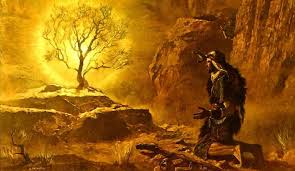
The middle period was spent in the wilderness tending the sheep of his father-in law Jethro. At the end of this period of forty years Moses has his famous vision of the burning bush.

Moses was keeping the flock of his father-in-law Jethro, the priest of Midian; he led his flock beyond the wilderness, and came to Horeb, the mountain of God. There the angel of the LORD appeared to him in a flame of fire out of a bush; he looked, and the bush was blazing, yet it was not consumed. Then Moses said, ‘I must turn aside and look at this great sight, and see why the bush is not burned up.’ When the LORD saw that he had turned aside to see, God called to him out of the bush, ‘Moses, Moses!’ And he said, ‘Here I am.’ Then he said, ‘Come no closer! Remove the sandals from your feet, for the place on which you are standing is holy ground.’ (Ex. 3:1-5)

Moses goes to investigate the burning bush to try to understand it, to put into one or another category of phenomena that he is familiar with. But the voice tells him “Take off your sandals, this is holy ground. You’re not going to approach this mystery on your terms but on mine!”

When was the last time you tried walking barefoot over rocky ground? It’s always a tentative operation, because you never know what’s coming next. Ouch! Martini paraphrases it this way: “Take your sandals off, because you are not going to come to me by enclosing me in your own ideas. You are not the one to integrate me into your personal synthesis. Instead, I want to fit you into my plan.”

AN EARTHQUAKE IN MY POCKET

I once heard someone make this remark about a fellow Christian: “His problem is that he thinks he has God in his pocket.” Having God in your pocket is dangerous business, as the Pharisees found out. They’re a perfect example of it, in fact. The God that they worshiped obeyed all of their laws scrupulously, including their Sabbath regulations! Some Christians have God safely trapped between the covers of their bible, others have God imprisoned securely in the tabernacle. Dangerous stuff!

With God safely in my pocket I quickly run afoul of the initiatives of the Lord, who always wants to fit me into his plan for the world. Maybe this is part of what the old rabbi meant when he said

"God is not nice, God is not your uncle; God is and earthquake."

As I was reflecting on these ideas recently, the father of one of my students died of cancer. If I showed you the faces of our hundred-some sophomores, you could probably pick him out easily. He is numb, devastated, swimming hard to keep his head above the flood waters of grief. He certainly does not have God in his pocket! I pray that he’ll soon come to realized that he is being carried around safe in God’s loving pocket.

THIS IS HOLY GROUND?

Back to Moses. God tells him to remove his sandals “for this is holy ground.” Imagine Moses’ confusion when he heard those words! He’d been living out in this deserted area tending sheep for forty years, this untamed, trackless abode of jackals, a place of desolation and aridity where no one would want to settle down and live. This desert where he had felt so lonely and wretched and frustrated for four decades – is he to believe that this is holy ground? This is God’s presence? This is the place where God reveals himself?

But it has to be that way. Why? Simply because God seeks Moses where Moses is, even if it is a place of desolation, the midbar, devoid of all resources. For Moses, precisely this is holy ground! Had God gone looking to encounter Moses in Pharaoh’s court or in Goshen, the encounter would never have happened. God met Moses where he was living and working, where he was feeling sorry for himself and wondering if his life had no more purpose than tending sheep. But because God appeared in the burning bush, Moses’ wilderness became holy ground, the place of encounter.

I’m going to concelebrate the funeral in the abbey church this afternoon for my student’s dad before the body is shipped back to Nigeria for burial. I want to be there for the family, especially for my student, and to pray for them that as they stand there in the wilderness of grief and loss, that they will somehow hear the voice that Moses heard in the wilderness reassuring them: “You are on holy ground!”
Maybe I'll take my shoes off, too.
.

m

Saturday, February 25, 2012

A VISION FOR LENT

FORTY DAYS IN THE DESERT

The gospel for the First Sunday of Lent this year is Mark’s version of Jesus’ temptation in the wilderness. The entire passage is only two verses long:

And the Spirit immediately drove him out into the wilderness. He was in the wilderness for forty days, tempted by Satan; and he was with the wild beasts; and the angels waited on him. (Mk 1:12-13)

Compared to the much more detailed versions of Matthew and Luke, Mark’s account seems disappointingly short on details. But if we concentrate on what he does tell us, we find some wonderful food for meditation.

First we should look at what Mark is saying. He surely intends (as do Matthew and Luke in their much longer accounts) that we should make the connection between the People of God who spent forty years in the wilderness, and Jesus “the New Israel,” who spent forty days there fasting and being tested. And perhaps more likely the gospel writers want us to recall the fast of Moses (Deut. 9:18) in the wilderness of Sinai, and that of Elijah near mount Horeb (cf. I Kgs 19:8).

I would like, however, to look at two interesting details in the second and final sentence in Mark: “He was with the wild beasts” and “angels came and ministered to him.”

THE BEASTS AND THE ANGELS

In the Old Testament wild beasts are associated with evil powers:


Many bulls encircle me,
strong bulls of Bashan surround me;
they open wide their mouths at me,
like a ravening and roaring lion. …
For dogs are all around me;
a company of evildoers encircles me.
(Ps 22:12,13,16)

Psalm 91 has angels protecting the psalmist from wild beasts.
For he will command his angels concerning you
to guard you in all your ways.
On their hands they will bear you up,
so that you will not dash your foot against a stone.
You will tread on the lion and the adder,
the young lion and the serpent you will trample under foot.
(Ps 91:11-13)

Finally, in the account of creation in Genesis the first humans coexisted peacefully with animals:
God blessed them, and God said to them, ‘Be fruitful and multiply, and fill the earth and subdue it; and have dominion over the fish of the sea and over the birds of the air and over every living thing that moves upon the earth.’ (Gen. 1:28)

So out of the ground the Lord God formed every animal of the field and every bird of the air, and brought them to the man to see what he would call them; and whatever the man called each living creature, that was its name. The man gave names to all cattle, and to the birds of the air, and to every animal of the field. (Gen. 2:19-20)


This kind of peaceful coexistence is also part of the hope of the renewed creation in Isaiah


The wolf shall live with the lamb,
the leopard shall lie down with the kid,
the calf and the lion and the fatling together,
and a little child shall lead them.
The cow and the bear shall graze,
their young shall lie down together;
and the lion shall eat straw like the ox.
The nursing child shall play over the hole of the asp,
and the weaned child shall put its hand on the adder’s den.
They will not hurt or destroy
on all my holy mountain;
for the earth will be full of the knowledge of the Lord
as the waters cover the sea.
(Isa. 11:6-9, cp. 65:24-25).

THE VISION OF PEACE
We can see in Mark's account of Jesus in the desert, then, a hint or a hope of the new creation of harmony and peace that will one day be brought about by Him.

The season of Lent is a good time for me to work at my part of bringing the “Peaceable Kingdom” into existence in my world and in my heart. During this holy season I can strive consciously to treat a certain person with more patience or compassion, I can take a step toward reconciliation with someone from whom I’ve become distanced. The ideas for “Lenten resolutions” in this area are countless.

What about bringing about the “peaceable kingdom” inside my own heart? Well, the idea of fasting is to lessen the hold that “the tempter” has on me precisely by taming, with God’s help, the unruly passions in me that try to run my life. Sort of like calling on the angels to help me with the “beasts” that threaten me. This is not about body-hating; in fact it’s just the opposite. The goal of my Lenten fast is that the world of instincts and the world of the spirit can come together in harmony so that I can live in tranquility with myself and with others, and so help bring about “that peace which the world cannot give.”

So, what about you? What specific things will you do during these forty days in the wilderness to help bring about Jesus’s dream of a “peaceable kingdom” in your heart and in your world?


"The Peaceable Kingdom" Edward Hicks (1780 - 1849)

.

Friday, December 9, 2011

AN IMAGE OF HOPE

MY FAVORITE CHANGE

I’d like to follow up last week’s post about the new English translation of the mass by reflecting briefly on one of my favorite changes so far, a particular metaphor that for some reason was omitted from the first translation of Eucharistic Prayer II but appears in the new one. Originally, you remember, the first paragraph of the Eucharistic Prayer II read:

Lord, you are holy indeed, the fountain of all holiness.
Let your Spirit come upon these gifts to make them holy,
so that they may become for us the body and blood of our Lord, Jesus Christ.

but the new translation reads,

You are indeed Holy, O Lord, the fount of all holiness.
Make holy, therefore, these gifts, we pray,
by sending down your Spirit upon them like the dewfall,
so that they may become for us the Body and Blood of our Lord, Jesus Christ.

The image of the Spirit’s descending “like the dewfall” has become an immediate favorite of mine.

Eucharistic Prayer II is based on a third or fourth century anaphora in a document called the Apostolic Tradition. When the post-Vatican II church used this ancient “anaphora” (canon of the mass) as the basis for a new Eucharistic Prayer, the word “dewfall” was imported from a seventh or eighth century text in the Gothic Missal, an example of how varied sources have contributed to the Catholic liturgical tradition over the centuries.

DEW IN THE BIBLE

In the arid land of Israel, especially in the dry months, dew was a major source of moisture and therefore life for all vegetation. Not surprisingly, then, Old Testament writers use the metaphor of “dew” fairly frequently. For instance, in Hosea the Lord says:

I will be like the dew for Israel:
he will blossom like the lily;
He will strike root like the Lebanon cedar,
and his shoots will go forth.
His splendor will be like the olive tree
and his fragrance like Lebanon cedar
(Hos 14:5, NAB)

Notice how the dew causes plants to take root and blossom grow in strength and beauty.


Then the psalmist compares the pleasantness of life in community to dew falling on a mountain, a sign of God’s blessing in this psalm:

How good and how pleasant it is,
when brothers dwell together as one!
Like fine oil on the head,
running down upon the beard,
Upon the beard of Aaron,
upon the collar of his robe.
Like dew of Hermon coming down
upon the mountains of Zion.
There the LORD has decreed a blessing,
life for evermore!
(Ps. 133:3).

Finally, in Isaiah the Lord asks the heavens to bring down the dew of righteousness in these words:

Let justice descend, you heavens, like dew from above,
like gentle rain let the clouds drop it down.
Let the earth open and salvation bud forth;
let righteousness spring up with them!*
I, the LORD, have created this
(Is. 45:8).

Of course, we moderns know that dew doesn’t fall from the sky but condenses on the ground, yet the metaphor is still a powerful and beautiful image. It has a more dynamic sense in other languages where “dropping like dew” is a single-word verb. Just as in English “rain” can be used as a verb (“It is going to rain”), so in Latin you can also say “It is going to dew (rorare).” In fact this is exactly the verb that was used when the above passage from Isaiah inspired the Latin Advent veriscle:

"Rorate coeli desuper et nubes pluant justum.
Aperiatur terra et germinet salvatorem"

(“Drop down dew, ye heavens, from above, and let the clouds rain the just one,
Let the earth be opened and bud forth a Savior").

This little verse was assigned in various places in the Advent liturgy to ask the heavens to send forth the savior like life-giving dew. It is also the first line of the beautiful Advent hymn, “Rorate Coeli.”

LISTEN FOR THE DEWFALL

In the past few days I've been asked to pray for a couple of little children whose father committed suicide, for someone addicted to drugs, for someone diagnosed with cancer. So, when I pray the “new” Eucharistic Prayer II these days, I’m conscious that I’m leading the community in a prayer for the Holy Spirit to come down upon the bread and wine "like the dewfall" so that just as those desert flowers draw life from the dew, all of us, especially those experiencing the sufferings of the desert in their lives, may draw new life and beauty and nourishment from the presence of the Spirit of God in the assembly and in the bread and wine on the altar.

So, I hope that whenever you hear Eucharistic Prayer II from now on, you too will be encouraged and inspired by the words “like the dewfall” and draw strength from this rich and ancient phrase and its image of flowers blooming in the desert -- a symbol of Advent hope at any time of the year!


A REQUEST: If you enjoy reading about my experiences with the new English translation of the mass, please let me know in the "comments" space so that I can decide if it's a worthwhile direction to pursue at least now and again in this blog. Let me know what you think.


.