Showing posts with label Education. Show all posts

Saturday, March 11, 2023

MY NEW FRIEND


I recently finished reading a captivating biography entitled Saint Katharine, the life of Katharine Drexel, by Cordelia Frances Biddle. I knew very little about Katharine Drexel before I read this book and I am now an enthusiastic a devotee of hers.

Let me borrow a paragraph or two from the introduction:


 "Katharine Drexel underwent an extraordinary transformation, from a pleasure loving young lady of privilege during the ¨gilded age¨ to a woman passionately committed to aiding and uplifting the poorest of the poor. Born in 1858, she inherited a fortune when her father died in 1885. Throughout the nation, newspaper headlines trumpeted the sum: his estate was worth $15.5 million. It was unthinkable for a woman to possess such staggering wealth. While her two affluent sisters followed the conventional route of marriage and the charitable activities accepted within their sphere, Kate shocked her family and friends by choosing a path of self-sacrifice and service, first, taking religious vows in the Roman Catholic Church, and then forming her own teaching order. Her cousins, ensconced in their sumptuous residences, considered her choice dangerously radical.


Katharine combated racial prejudice and fought the Ku Klux Klan as she traveled through the country establishing schools for African and native Americans. She considered Xavier university in New Orleans a crowning achievement, but of equal importance was her tireless work on behalf of the Navajo and Pueblo nations….
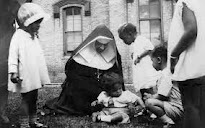

At a time when journeys to the Dakotas, Wyoming, Arizona, and New Mexico were fraught with peril because of the government´s repressive policies, she overcame bigotry, distrust and threats of murder. She died in 1955, having devoted her considerable energies to uplifting America’s forgotten peoples.”


The first part of the book is filled with details of her early life as a young socialite, a member of one of the wealthiest families in Philadelphia. There were trips to Europe and travel to fancy resorts, and all of the intrigues of high society personalities.


The second part describes her founding of the Sisters of the Blessed Sacrament, and her many perilous trips to Indian reservations and poor Negro neighborhoods in the south, in spite of the threats and opposition that she encountered at every step until her death at the age of 97.


What most captivated me was the crucial and difficult period of what Biddle calls Katharine's "extraordinary transformation," the transition from a rich socialite to a very observant religious sister who practiced poverty that today would seem extreme. Just think about it: how do you change from that rich young socialite to that committed religious? The answer is one of the main points I got from the book, namely that she was able to hand things over to the Lord: from the craziness of leaving her former life to the craziness of founding schools on Indian reservations, or in locations where white neighbors despised what she was doing.


A second point that impressed me was Katharine's deep conviction that everything that she and her religious sisters were doing was God’s work and not hers. She was convinced that God was accomplishing his will through her faceless activity and relentless forging ahead in the face of every imaginable adversity.


This second point is an excellent one for me to reflect on during this year when our community is celebrating the 50th anniversary of our reopening Saint Benedict prep. (As an insider, I have always been convinced that whatever we may be accomplishing here is obviously not our own work but the Lord's.)


That first point, however, about leaving everything in God's hands, is something that I´m still working on, a grace that I hope the Lord will entrust to me someday. 


Meanwhile, I’ve begun praying to Saint Katharine to intercede for me on that one!
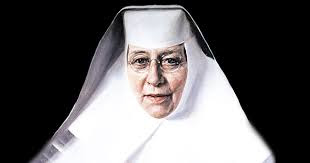


Saint Katharine, pray for us!


Saturday, June 6, 2015

LESSONS FROM THE FILE DRAWER

.
THE TALE OF THE FILING CABINET

Yielding to the impulse of the moment I spent the past several days thoroughly weeding out old file folders from drawers in my offices in both monastery and school. What an interesting experience!  


There were lots of folders that I had not looked at in decades, such as class notes from graduate school, and newspaper articles, and other odds and ends. These simply went into the big paper recycling dumpster. A second category of folders contained material destined for the archives of our monastery and school. I did glance into a lot of these, and found some interesting things, such as a yellowed sheet of looseleaf from  1972 filled with pencil-written notes outlining the shape of a possible school, or another from one year later containing a handwritten list of students from one of the first classes I taught in our newly reopened St. Benedict’s. Three boxes of such things went to the archives.

Two things struck me about the experience of sorting through these old files. First, when I looked at the titles on the folders full of class notes from grad school and seminary and old news articles I realized that all of the things in those folders had contributed to shaping my attitudes and approaches into what they are today. I didn't feel the least need to peek into any of those files -- their contents had become part of me (or not), and so the paper they were written on could now safely be recycled.


I was reminded especially of how all those various ideas had helped shape my thinking back when we were giving form to the “new” St. Benedict’s Prep: Cultural Anthropology, Secondary School Administration, Counselling, Racism, Martin Luther King, Epistles of St. Paul, Curriculum Design, and on and on.


A second aspect of the experience was getting reacquainted with the Albert who had studied those courses and had written those scores of outlines, memos, proposals and lists at age 29 or 30. I tried to remember what it felt like to be doing all that stuff, to be so filled with energy and enthusiasm that I’d stay up past midnight to try to get it all on paper. As I sifted through those sheets that were now on their way to the archives I smiled, trying to recognize the young man who had written all that stuff.

SO?


Now, of course I’m left with the question “So what?” What’s the upshot of the experience of emptying these file drawers? For one thing, I realized that as important as these ideas were, the intellectual was only one side of me, perhaps the most obvious and certainly very useful, but ultimately not the most important dimension of who I am. There are no file cabinets full of all those experiences and people that shaped my character and my moral fiber.


It got me to thinking about the various influences that shape our lives and our characters. Yesterday, the final day of school, the students and faculty watched a retrospective slide show about the graduating seniors, sometimes  laughing at the pictures of them as seventh graders or freshmen. Then we had the ceremonial installation of the new student leaders for next year, and the official promoting of the freshmen into full membership in the community (meaning that now they will wear a black hoodie instead of a gray one). During the whole time this was going on I was aware of how much we are shaping these kids' lives by everything we do here in school here both intellectually and in terms of character education and religious belief. I said a prayer that I can do a good job of holding up my end of that task.


Last night there was a reception for the class of 1965. Several of these alumni volunteered to me that St. Benedict’s had been one of the most formative experiences of their life. More thoughts about how we help to shape one another.


Then just a few minutes ago I was in the gym shaking hands with kids who will be coming here next year as new students. More shaping to be done!

THE MOST IMPORTANT LESSON?


Maybe the most important lesson for me to take away from this week is not that I’ve been shaped by so many people, or that as a school person I have helped to shape thousands of young people over the years, but rather this: I am not yet fully formed, and God is going to continue to shape me and challenge me and encourage me.

God said to me this week, “I love you just the way you are, but I love you too much to leave you the way you are. So be prepared for more growing. I’m not finished with you yet!”
.

Saturday, January 24, 2015

THE BIBLE FOR REAL

X
Each time I teach my New Testament course, at some point I pull out this long strip of shiny paper (18” x 5 feet) containing a map of the Holy Land. What’s unique about it is that it’s not a drawing but an actual full-color photograph taken from a satellite. My enthusiasm for this “map” usually spills over to the kids as they locate real places mentioned in the gospels: the Dead Sea, the Sea of Galilee, the coast of Tyre and Sidon, etc. Several New Testament towns are discreetly labeled in small yellow letters that you only notice if you get up close.


I point out to the students that this photo reminds us that the gospel stories are situated in real places, as real as Irvington and Newark. God took flesh and walked among us in Nazareth (you can find it on the map!) and called his first disciples on the shore of the Sea of Galilee (which is much easier to locate).

With sophomores you always want to make sure you get to the “So What?” part fairly quickly before they ask, "So who cares about this map?" I tell tham that for me the satellite photo says something like this: These places on the map are every bit as real as your own home town; God worked wonders in Israel during Old Testament times and eventually actually came and lived there. So why shouldn’t this same God be working wonders in our cities and towns and homes and hearts?

When this Sunday’s Gospel says that Jesus was walking along the shore of the Sea of Galilee I picture the satellite image of Israel and then with my mind's eye I zoom in (like you do on Google Maps) to a very specific spot on the shore of the sea. This is a real place! So it’s easier for me to then imagine a real Jesus talking to real fishermen and calling them.

And maybe more important, it’s also easier for me to imagine Jesus coming to Newark (a place as real as Capernaum) and calling me (a person as real as Andrew or James). I can more easily imagine him calling me in that same tone of voice he used with those first disciples, “Come, follow me!”

In fact, he keeps calling me over and over, again and again: “Come, follow me!” I hope that my response will be as real as the response of those four fishermen on the shore.

As real as the Sea of Galilee that you see on the map.
x

x
x

Saturday, January 17, 2015

A HIGH-RISK BUSINESS


x
In the past 20 hours I’ve become aware once again of what a high-risk business it is to educate inner-city boys.


Robert. Last night I participated in a lively  discussion of a book entitled “The Short and Tragic Life of Robert Peace,” a pretty accurate biography of a very bright african-american alumnus of ours who went to Yale, graduated with a degree in molecular biochemistry, and returned here to teach and coach. I always considered him one of our greatest success stories. After he moved on from teaching in our school I lost track of him until his name appeared in the newspaper: He had been murdered in his basement where he had been using his scientific knowledge to raise marijuana to the tune of hundreds of thousands of dollars. And so a bullet ended the short and tragic life of Robert Peace. During the discussion someone asked me whether I thought that St. Benedict’s had failed Robert. Interesting question about a guy who managed to live two lives in order not to have to face his demons.


Rodrigo (not his real name). At a noontime faculty meeting yesterday we had a presentation from the head of our terrific guidance department detailing the services that they provide (which are unrivalled by any high school around). The Director, an alumnus of ours, congratulated the faculty on the way we have been spotting kids who are in difficulty and referring them to his office. He then introduced Rodrigo who graduated from our school just last year. We all know him, of course. He’d been an angry, angry kid but somehow he was able to start trusting the adults around him and to receive counselling. So there he was yesterday standing nervously in front of us wearing dark slacks, a white shirt, a necktie and a broad smile. He told us that, in the simplest terms, we had saved his life, and contrasted his situation with that of a friend who had quit St. Benedict’s in favor of the street and ended up getting shot and is now a paraplegic. He told about his struggles with his Freshman Algebra teacher (she was sitting in front of him) as a prelude to announcing that he’s currently a math major and hopes to come back to St. Benedict’s one day to teach. We gave him a round of encouraging applause. He’s a success story - so far.


Larry (not his real name). At 7:15 this morning I found myself sitting on a bench in the lobby next to an unkempt 30-something street guy who was wearing a dirty woolen cap. I remember the day he walked across our stage at his graduation and triumphantly held up his diploma for all to see, the result of five years of struggling. He’d gone off to Rutgers Newark full of hope to major in pre-law. Then mental illness (made worse, I assume, by drugs) put a brutal end to his dreams and left him the way he is now.


TALE OF THREE GUYS


Ty Cobb
So that's only one success story out of those three students. Sometimes I take comfort in the thought that educating the kids we work with is much more like baseball than it is, say, computer programming. A successful programmer’s programs have to work 100% of the time or he’s considered a lousey programmer; “most of the time” is not good enough. On the other hand, the best hitter in major league baseball this year batted .341 - that’s only about one a hit for every three times he was at bat. Ty Cobb’s lifetime batting average of .364 puts him way ahead of the next best hitters. So, compared to Ty Cobb’s percentage at bat, we’re doing a spectacular job over all.


It’s important, too, to ask the right questions. Don’t ask “What do we consider an acceptable dropout rate in our school?” Ask “What can we do to address the dropout rate?” Don’t ask, “Did we fail Rob Peace?” but “Is there something we can learn from Rob’s experience here that we can use to help other kids like him?


“The Rule”

A couple of minutes ago I saw a film catalogue open to the page entitled “new releases,” with a film circled in
Scene from Bongiornos' "The Rule"
blue pencil. The circled item was the documentary about us and our school entitled
“The Rule.” The blurb in the catalogue touts our school as having an almost 100% college acceptance rate and so forth, the description being, I believe, pretty accurate. By most criteria we’re a success story, and we can be justly proud of what the Lord has done through us for thousands of kids. Still, Rob Peace and Larry stand as stark reminders that this is still a high-risk enterprise and we’ve got to keep striving to get better at it.

Please pray for us and for our kids.

Saturday, January 10, 2015

2015: SKIPPING THE RESOLUTIONS

x
Around January 1 I saw an article entitled something like “Instead of New Year’s Resolutions Try a Mission Statement.” I didn’t read the article, but the headline was all I really needed. It sounded like a good idea - for several reasons. I won’t even bother critiquing the whole silly idea of making promises to oneself every January first.


I googled “mission statement” and got almost 18 million hits.  One way of understanding the phrase would be that a mission statement talks about HOW you will get to where you want to be. It defines your purpose and primary objectives related to your core values.


It’s not a “vision statement” (which is about the future). Maybe that’s what new year’s resolutions are, vision statements: You envision yourself losing twenty pounds in the coming year.


So when a friend asked me “What are your new year’s resolutions this year?” I immediately thought of that unread article with the fascinating title, and emailed back “I’m not doing resolutions, I’m doing a mission statement.” And at the same moment I realized that at the turn of the year I had indeed written a couple of ideas in my prayer journal that sounded like a mission statement, so I’ll share them with you.


Jan. 4, 2015.  Mother Teresa truly believed that text from Matthew, “Whatsoever you do to the least one, you do it to me.” Maybe a 2015 resolution can be to truly make that a practical guiding principle for myself in my admittedly closed little world.
Please then, Lord, give me the gift of finding you in everyone, especially in the people I find difficult to be kind and generous to.


Jan. 5, 2015. Mother Teresa once told Malcom Muggeridge the goal of her sisters working with the poor: “We want to make them feel that they are loved.” Now, how’s that for a goal for a classroom teacher? It’s a wonderful goal, a new year’s resolution.”  


It was the next day that my friend asked me what my 2015 resolutions were. Alhough I hadn’t even remembered using the word “resolutions” in my journal, I was well aware that I’d written some important ideas for myself that had to do with how I could live out my Christian calling.


So, I hope that not too many of my acquaintances, students or relatives read this post, because they’re going to see how often I fall short of my mission statement.  Resolutions get “kept” or they get “broken,”but mine is not a resolution that can be broken,it's “a statement of how I will get to where I want to be,” something against which I can measure my behavior maybe, or a guide that can help me to make the right decisions relative to who and where I want to be.


An obstreperous sophomore starts acting out in my class. Mother Teresa’s voice whispers that
missions statement: “We want to make them feel that they are loved.”


Someone interrupts me while I’m doing something I consider important, and asks if I have a couple of minutes. I dont. But then that line from Matthew sounds in my ear: “Whatsoever you do to the least one, you do it to me.”

Yeah, I think maybe this could work. Let’s see if it lasts longer than a resolution.

Saturday, October 25, 2014

TURNING OVER ROCKS (Part 2)

X
ME AS ANGEL

I was standing in the entrance foyer at the end of school earlier this week waiting for one of my kids who said he needed to talk to me after school about something that was bothering him. Frankly I was pretty low on energy at that time of day, but of course I went downstairs to meet him. As I was scanning the crowd of teenagers for him a student who I didn't recognize walked up to me and said "Fr. Al, can I talk to you for a minute, please? So we stepped into a relatively quiet corner of the room. As soon as he started to speak I recognized him as the kid whose ID card I'd turned over to the Dean of Discipline (see last week's post) for being snotty to me.

"I want to apologize for being disrespectful to you the other day." He was obviously sincere, even if the apology was being made under orders from Mr. Rowe. But after I accepted his apology he continued, "You know how they say there are angels that watch over us and help us all the time? Well, the other day when you took my ID card I guess you were sort of one of those angels. I was having a hard time dealing with some stuff and holding it all inside; but as soon as I sat down with Mr. Rowe it just started coming out. If you hadn't taken my ID card that wouldn't have happened. So, thank you! I'm going to my first meeting of 'Unknown Sons' tomorrow morning." His big smile was enough to pump my energy level back up to "full."

FULL DISCLOSURE

The next day I came across a passage in a book by Fr. Michael Casey entitled "Seventy-Four Tools for Good Living" that happens to fit in with the gospel for Sunday Oct. 26 (the two great commandments of love of God and love of neighbor in Mt 22:34-40). I really sat up straight when I read this sentence about Christ's command to love ones neighbor:

"The distinctive love by which Christians are recognized is not merely the result of an affectionate nature or the acquisition of skills or a suitably nurturing social situation."

A humanistic atheist would explain everything that we monks do in our school, including what had happened with that kid the previous afternoon, as a collection of humanistic deeds of altruism "based on our personalities, our training and the supportive school environment we've created." It's true that all of these are present, but actually the student himself had hit it on the head when he said "I guess you were sort of one of those angels."

Once again I see why the Bongiornos, when making "The Rule," the documentary about the monastery and school, (see top of the left sidebar) inisisted, with their documentarians' love of "full disclosure," on including so much about our prayer life in the film. They felt that a story that portrayed us as simply altruistic humanists would be leaving out a central part of the story.

The passage from Casey continues:

[Love] is a gift of God which both fulfills and simultaneoulsly surpasses our nature's desire to be loved and to love. Christian love (or agape) is the infusion of the divine loveableness and love into the himan spirit, repairing the damage which love's absence has wrought and lifting up the human to the level of the divine. Simultaneously, it is an upgrading of our perception so that we are able to see just how lovable our neighbor is. This gift enables us to see through the objective failings of other persons to reach the inner core of their being, where everything is beautiful. This is not a human quality or skill but a gift of God that is both sign and guarantee that we are already living on a supernatural plane.

Such love is a gift because it cannot be self-generated. It arises out of an encounter with God.

When I got to speak with that second student, the one who'd asked to see me, it turned out that his father is nowhere around, and didn't even phone him on his birthday.  As I sat listening to him, I was really aware of Michael Casey's reminder that this little encounter was primarily a privilege, a gift from God, repairing the damage which love's absence has wrought and lifting up the human to the level of the divine. 

Made me feel "sort of like one of those angels."
X

Saturday, September 21, 2013

WHAT'S THE DIFFERENCE?

 .
WHY DOES IT WORK?

By about January 2014 the documentary “The Rule” will be ready for public viewing (by that time all the required permissions for copyrighted photos etc. will have been be obtained). Meanwhile there have been private showings of this 90-minute documentary film about Newark Abbey and our school.

One comment that keeps coming up in discussions at these screening goes like this: Granted that the educational model used by St. Benedict’s Prep works well for inner-city teenagers, the reason it works is because of the presence of the monks. To replicate it you need a community of dedicated monks. 
Another is "Public schools could never use this model because it's religious." I was really surprised when Columbia Teachers College in New York (my alma mater) adopted the movie as a model for urban education and agreed to write an accompanying curriculum to be used in conjunction with it. Obviously they must see something there besides a bunch of Catholic monks. 

So, how do you tease apart the various threads here? For starters, is our school so effective because it is run by people who are monks or because it is run by people who are dedicated? To what extent is it our religious outlook that is responsible for the success of the school? Could many or all aspects of our program be successfully replicated by atheists who were passionately dedicated to the welfare of the kids?

I would love the get some comments from you, the readers of this blog, concerning this topic.

DETECTING THE GOSPEL

What would be different about our school if we were, like a public school, prohibited from referring to God? I recently described eighteen of our school's fundamental principles in several single-spaced pages without referring once to God. Here are the just four of the eighteen principles minus the practical examples I included in the original:

1. A school is a community of learners made up of students, teachers and staff, and not simply an organization composed of interchangeable parts.
The more connected a student feels to the school as a community the more he is willing to invest in his education. The school will foster a sense of “family,” linking the destinies of teachers and students through shared experiences and situations in which they begin to feel responsible for one another.

3.  Success is defined as much in terms of effort as it is of results.
Success in life is not judged by merely financial or material measures. The school emphasizes the importance of putting in effort, staying with a task and giving it your best. Mistakes are a normal part of living and need to be valued and used as learning experiences.

6. The school is like a ship composed entirely of working “crew;” there are no entitled “passengers” along for the ride.
Students will be responsible for such concerns as the cleanliness of the building and the maintaining of general order. They will play a meaningful role in the decision-making process at a variety of levels, especially via leadership roles in the everyday running of the school

7. Adults in the school will not do for students things the students can do for themselves.
Adolescents are capable of far more than they are usually given credit for. Therefore the school requires students to take leadership roles in certain tasks involved in running the school such as the maintaining of good order and the planning of school events. Adults must expect and accept that some ambiguity, inefficiency and mistakes are going to result from this arrangement.

These and the other principles we use are based on our convictions about what makes kids tick, and on common sense. To what extent are they also based on the Gospel? (Or maybe the difference lies in the monks' motivation? My work in the school is my way of obeying Jesus' command to love one another.)

TEST CASE

Let me offer as a practical example something that happened to me the first week of school. I have a new sophomore in my class, a transfer from a local city high school. On the second day of school he came late and did not have his homework. So I very quietly suggested in an angry voice that he should just go back to the public school where he could do that for free, and stop wasting my time. I was really hard on him. Then that night I called him at home to ask if he was having any trouble with the homework, and asked him what bus he was going to take the next morning so he’d be on time.

My question to you is: Was my phone call prompted by my belief in the Gospel, or on the Rule of Benedict, or was it simply the action of a good teacher who sensed that this particular kid needed some extra support at the moment? The answer doesn’t matter to that student, all he knows is that his teacher called him at night to ask if he needed help with the homework and to remind him to take an earlier bus.

The incident raises lots of interesting questions that any of us Christians can ask ourselves. For example, “How different would my relations with others be if I were not a believing Christian?” “How many of my moral decisions are based on my belief in Jesus and his call to love?” “Would I be pretty much the same person I am even if I had never heard of Christ?”

Even if there’s no way to answer these questions with certainty I think they’re worth asking. So now I’ve started asking myself to what extent my actions and thoughts as a teacher or as a brother in community reflect my professed commitment to Jesus and his program that he calls “The Kingdom of God.”   

If you have an opinion on any of these ideas, please share it with the rest of us by leaving comment.